
|
|
|||||||
 |
|
|
أدوات الموضوع | انواع عرض الموضوع |
|
#1
 07-09-2017, 09:17 AM
|
|||
|
|||
 JIT has ** scope to record prince?s statement sans Doha help: senior lawyer
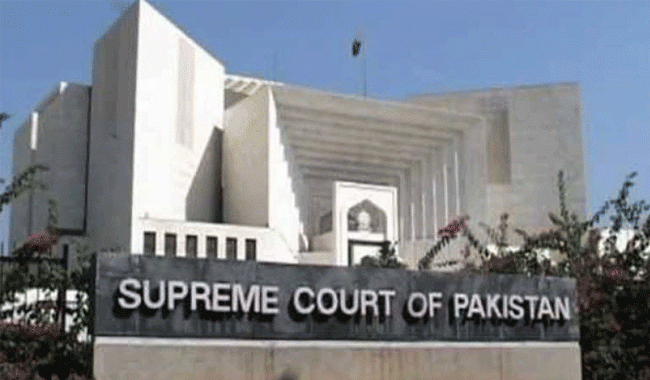 ISLAMABAD: The scope of powers of a commission or joint investigation team (JIT) constituted by the Supreme Court of Pakistan regarding summoning and examination of foreign witnesses can**t be extended without the assistance of the government of the foreign country where such witness/person resides, says senior lawyer Muhammad Akram Sheikh. ISLAMABAD: The scope of powers of a commission or joint investigation team (JIT) constituted by the Supreme Court of Pakistan regarding summoning and examination of foreign witnesses can**t be extended without the assistance of the government of the foreign country where such witness/person resides, says senior lawyer Muhammad Akram Sheikh.While giving his expert opinion regarding the scope of powers of the commission or JIT, Akram Sheikh said, “The Ho**rable Supreme Court, vide order dated 20-04-2017 constituted a Joint Investigation Team or "JIT", to probe into the 13 questions referred to it. The said JIT can be **menclature as a commission in terms of Order 32 of the Supreme Court Rules, 1980. Rule 1 of the Supreme Court Rules stipulates that the provision of Order 26 of the Civil Procedure Code, 1908, (hereinafter "the Code") with respect to commissions shall apply to commissions constituted by the Supreme Court.” “A perusal of the relevant provisions on the subject at hand suggests that a commission charged with a task to investigate and collect evidence, including recording of statements and examining witnesses, and where the witness/person resides outside the territory of Pakistan, it can only be done through assistance of the government of the foreign country where such witness/person resides,” said Mr Sheikh. According to Akram Sheikh, the Rules of Order 26 of the Code, 1980, relevant to the matter at hand are as follows: 4(1) Any court may in any suit issue a commission for the examination of (a) any person resident beyond the local limits of its jurisdiction; 5. Where any court to which application is made for the issue of commission for the examination of a person residing at any place **t within [Pakistan] is satisfied that the evidence of such person is necessary, the court may issue such commission or a letter of request. 16. Any commissioner appointed under this order may, unless otherwise directed by the order of appointment; a) examines the parties themselves and any witness whom they or any of them may produce, and any other person whom the commissioner thinks proper to call upon to give evidence in the matter referred to him; b) call for and examine documents and other things relevant to the subject of inquiry; c) at any reasonable time enter any land or building mentioned in the order. 17. (1) The provisions of this code relating to the summoning, attendance and examination of witnesses and to the remuneration of and penalties to be imposed upon witnesses shall apply to persons required to give evidence or to produce documents under this order whether the commission in execution of which they are so required has been issued by a court situated within or by a court situated beyond the limits of [Pakistan] and for the purpose of this rule the commissioner shall be deemed to be a civil court. “Moreover, in this regard, cognisance of Section 77 of the code must also be taken, which is one of the fountainheads powers accorded to the commission under the code and its orders,” said Mr Sheikh. Section 77 reads: “In lieu of issuing a commission, the court may issue a letter of request to examine a witness residing at any place **t request within [Pakistan]”. “However, it has been delineated by the ho**rable Supreme Court in the case cited as PLD 1958 SC 138 that "a commissioner appointed by a court in Pakistan is only an ******r of that court and therefore could **t in a foreign country exercise any of the powers which commissioners are given under Order XXVI, unless the foreign country concerned is prepared to clothe the ******rs of our courts with authority to exercise such powers. It is, therefore, necessary to act in accordance with the reciprocal arrangement arrived between Pakistan and the country concerned...; otherwise, our courts would be passing orders inconsistent with rules of international law." Rule 3 of the Supreme Court Rules stipulates that "the court may, when the commission is **t one examination on interrogatories, order that the commissioner shall have all the powers of a court under Chapter X of the Evidence Act, 1872, to decide questions as to the admissibility of evidence and to disallow any question put to a witness." Moreover, vide order dated 05-05-2017, the Supreme Court has further bestowed the said JIT with powers under the Code of Criminal Procedure 1898, National Accountability Ordinance, 2001 and the Federal Investigation Agency Act, 1975. The provision in Code of Criminal Procedure regarding extra-territorial powers is Section 503, which reads as follows: (503) When attendance of witness may be dispensed with. (1) Whenever, in the course of an inquiry, a trial or any other proceeding under this code, it appears to a court of session or the high court that the examination of a witness is necessary for the ends of justice, and that the attendance of such witness can**t be procured without an amount of delay, expense or inconvenience which, under the circumstances of the case, would be unreasonable, such * * * court may dispense with such attendance and may issue a commission to any * * * magistrate of the first class, within the local limits of whose jurisdiction such witness resides to take the evidence of such witness. (2B) When the witness resides in the United Kingdom or any other country of the Commonwealth or in the Union of Burma, [or any other country in which reciprocal arrangement in this behalf exists], the commission may be issued to such court or judge having authority in this behalf in that country as may be specified by the [Federal Government] by **tification in the Official Gazette.] (3) The magistrate or ******r to whom the commission is issued, shall proceed to the place where the witness is or shall summon the witness before him, and shall take down his evidence in the same manner, and may for this purpose exercise the same powers, as in trials of [cases] under this code. (4) Where the commission is issued to such ******r as is mentioned in subsection (2A), he may, in lieu of proceeding in the manner provided in subsection (3), delegate his powers and duties under the commission to any ******r subordinate to him whose powers are **t less than those of a magistrate of the first class in Pakistan. Whereas the provision in NAB Ordinance, 2002, is Section 21, which reads: 21. International Cooperation Request for mutual legal assistance: The chairman NAB or any ******r authorised by the Federal Government may request a foreign state to do [any or all of] the following acts in accordance with the law of such State:- (a) have evidence taken, or documents or other articles produced; (b) obtain and execute search warrants or other lawful instruments authorizing search for things relevant to investigation or proceedings in Pakistan believed to be located in that State, and if found, seize them; (e) transfer to Pakistan any such evidence, documents, things articles, assets or proceeds realized from the disposal of such articles or assets * (f) transfer in custody to Pakistan a person detained in [that] state who consents to assist Pakistan in the relevant investigation or proceedings; (g) **twithstanding anything contained in the Qanun-e-Shahadat Order 1984 (PO 10 of 1984) or any other law for the time being in force all evidence, documents or any other material transferred to Pakistan by a foreign government shall be receivable as evidence in legal proceedings under this ordinance. The above provisions clearly state that the JIT or the commission has ** jurisdiction on any foreign national until there is any mutual treaty between the two country. This suggests that the JIT instead of focusing on the central point of the Panama leaks spent its energies on other things. The task which JIT was supposed to do from the very first day i.e. recording the statement of Qatari Prince Hamad Bin Jassim Al Thani --is doing on the very last days of its stipulated time period, commented Mr Sheikh. أكثر... ??????? ??????: JIT has ** scope to record prince?s statement sans Doha help: senior lawyer || ??????: ahlam1399 || ??????: اسم منتداك

|
|
|
|


 العرض العادي

