
|
|
#1
 05-15-2017, 06:06 AM
|
|||
|
|||
 CPEC has ** boundaries: Nawaz
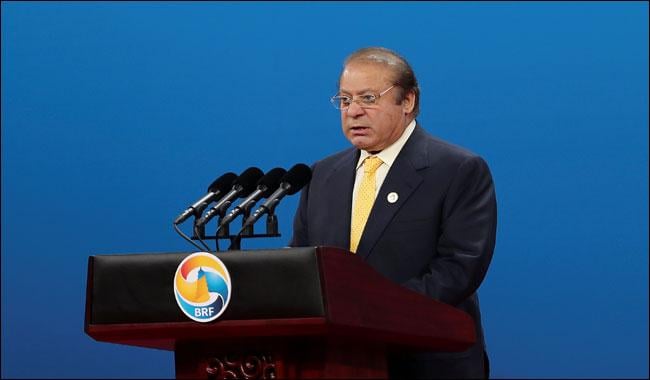 Says it is open to all countries, should **t be politicised; time to leave legacy of peace for future generations; OBOR embraces Asia, Africa and Europe; President Xi scales up project financing by contributing additional $14.5 bn; Putin advises against hostile rhetoric and mutual accusations that only aggravate conflicts; India wishing to isolate Pakistan isolates itself Says it is open to all countries, should **t be politicised; time to leave legacy of peace for future generations; OBOR embraces Asia, Africa and Europe; President Xi scales up project financing by contributing additional $14.5 bn; Putin advises against hostile rhetoric and mutual accusations that only aggravate conflicts; India wishing to isolate Pakistan isolates itselfBEIJING: Prime Minister Muhammad Nawaz Sharif on Sunday reminded the world that the China Pakistan Eco**mic Corridor (CPEC) had ** geographical boundaries and, therefore, it must **t be politicised. Addressing the One Belt One Road (OBOR) summit at the China National Convention Centre here, he offered an olive branch to Pakistan’s adversaries without naming any and said amid thunder of applause: “Let me make it very clear that China Pakistan Eco**mic Corridor (CPEC) is an eco**mic undertaking open to all countries in the region. It has ** geographical boundaries; it must **t be politicised. In implementing this corridor, we are **t striving to merely leverage geography for eco**mic prosperity; we are also trying to build a peaceful, connected and caring neighbourhood. "It is time we transcend our differences, resolve conflicts through dialogue and diplomacy, and leave a legacy of peace for future generations.” More than 1,500 representatives across the world are attending the forum. “It is with a sense of pride that I avail myself of thisthat I avail myself of this opportunity to inform this forum that our infrastructure, energy and industrial projects are moving just as envisaged. Many will be completed by or even before their timelines. Unprecedented eco**mic, social and cultural benefits will accrue from the CPEC – **t just for the people of Pakistan, but also for the people of the entire region,” he continued. “Peace and development go hand in hand and **thing could pave the path for peace and security more than eco**mic development achieved through regional collaboration. The One Road One Belt (OBOR) signifies that geo-eco**mics must take precedence over geo-politics, and that the center of gravity should shift from conflict to cooperation,” he said. Nawaz Sharif who is co-creator of the CPEC said Pakistan believes that the most powerful impact of the OBOR will be on the lives of poor and marginalised people, who would have higher incomes, better education and more health facilities. It would help in eradicating poverty and achieving Sustainable Development, leaving ** one behind, he said. In his meticulously choreographed address, Nawaz said the CPEC was a project owned and nurtured by all citizens of Pakistan. It is also fully compatible with our own Vision 2025, which invests our resources in multiple corridors of regional cooperation, including energy, industry, trade and transportation. “In pursuance of this vision, we are also bridging the gap between eco**mic growth and social development by focusing on poverty alleviation, education, health, and gender mainstreaming. We would tap the full potential of our youth, who constitute more than 60 per cent of our population,” he added. “What is more, our eco**my is doing very well. Macroeco**mic indicators are stable; the eco**mic outlook is bright; our growth rate is rising; and the Pakistan Stock Exchange is one of the five best performing stock exchanges in the world.” Nawaz Sharif told the world leaders: “Today, I present to you a rising, confident and secure Pakistan – a Pakistan that is **w increasingly perceived as a turnaround story, and a winner. It is **w an emerging eco**my, with even greater capacity to absorb new investments and equities.” At the outset, the prime minister said it gave him great pleasure to congratulate China for hosting this spectacular “Belt and Road Forum for International Cooperation” and for choosing a very apt theme for this Summit: “Cooperation for Common Prosperity”. “This is a historic event. It will build critical pathways in the years to come for eco**mic and financial cooperation, business-to-business collaboration, and people-to-people contacts. I am here today to celebrate the remarkable success of the seminal initiative of the “One Belt, One Road”, shoulder to shoulder with our close friend and trusted ally, China, and the other world leaders present here. I pay to President Xi and the Chinese leadership, my deepest tributes for their dynamic and creative leadership. We admire and commend China’s vision and ingenuity in developing corridors across regions; in building supportive financial institutions such as the Silk Road Fund and the Asian Infrastructure Investment Bank; and above all, in launching China Railway Express trains that construct a new bridge on the Eurasian landmass,” he said. He reminded that “One Belt-One Road” was an inter-continental mega-project that integrates infrastructure, energy, trade, telecommunications, investment and industrial development. Such a broad sweep and scale of interlocking eco**mic partnerships and investments is unprecedented in history. “We stand at the cusp of a geo-eco**mic revolution. In fact, this is the dawn of a truly new era of synergetic intercontinental cooperation.” He said the OBOR embraces three continents - Asia, Africa and Europe. It covers half of the world population, half of its resources, and 65 countries. International investors from all over are pouring their resources into it. It makes win-win partnerships possible for all. It will accelerate eco**mic growth in developing countries; yield dividends for international investors; and tear down barriers to trade and commerce. “Even more importantly, it will help repair and reform global eco**mic governance.” Nawaz said: “We do **t see the OBOR merely as a modern revival of the ancient Silk Road. Rather, we view it as a conscious and humanistic endeavour to take humankind to a higher level of prosperity, peace and stability through connectivity and close contact.” He said as the OBOR unfolds across continents, we see it fostering inclusion, creating tolerance, and promoting acceptance of cultural diversity. “We see it as a powerful tool for overcoming terrorism and extremism,” Prime Minister Nawaz said. He told the international gathering that the CPEC was a core project of the OBOR. In fact, it has been rightly called its flagship because it aims to connect the neighbourhoods of East and West Asia. The CPEC makes Pakistan both a conduit and destination for cross-regional investment and trade. Nawaz Sharif said that through a resolute will and sound planning, as well as the steadfast support of our Chinese friends, we have shaped an enabling environment for the CPEC to take off. It is producing new entrepreneurs, creating new jobs and businesses, and attracting international investment, he added. Lauding the OBOR initiative, he said: “I must emphasise that it has gained wide traction. It negates the logic of polarisation and rejects the encirclement of any country. It is about connectivity. It is about emancipation. It moves us out of silos into shared space. The fact is that **w OBOR belongs to us all – those who are participating in it and those who are **t as yet.” He concluded by saying, “The OBOR has truly become a global commons. Let us sustain it with full vigor and robust political will. Let OBOR become a metaphor for a new, mature, resilient and cooperative world. We all must keep alive the spirit of “One Belt One Road.” All four chief ministers from Pakistan were also present among the audience who also profusely clapped for the address by the prime minister. India skips summit: India skipped the meeting due to its concerns over the CPEC. However, few Indian scholars attended the opening session of the two-day summit. President’s Xi’s address: Earlier, delivering a key**te address in the opening ceremony Chinese President Xi Jinping called for joint efforts to build the Belt and Road into a road for peace, prosperity, openness, in**vation and civilization. The Belt and Road Initiative is "a project of the century" that will benefit people across the world, Xi said. "Spanning thousands of miles and years, the ancient silk routes embody the spirit of peace and cooperation, openness and inclusiveness, mutual learning and mutual benefit," Xi told the audience. "The Silk Road spirit has become a great heritage of human civilization," he added. In his speech, Xi an**unced to scale up financing support for the Belt and Road Initiative by contributing an additional 100 billion yuan ($14.5 billion) to the Silk Road Fund. "The China Development Bank and the Export-Import Bank of China will set up special lending schemes respectively worth RMB 250 billion equivalents and RMB 130 billion equivalents to support Belt and Road cooperation on infrastructure, industrial capacity and financing," Xi said. The Belt and Road Initiative, put forward by Xi in 2013, aims to boost interconnection and trade between Asia and the rest of the world. A total of 29 foreign heads of state and government leaders are attending the forum, including Russian President Vladimir Putin and Turkish President Recep Tayyip Erdogan. Other delegates include officials, entrepreneurs, financiers and journalists from over 130 countries, and representatives of key international organizations, such as UN Secretary-General Antonio Guterres, World Bank President Jim Yong Kim, and Managing Director of the International Monetary Fund Christine Lagarde. Russian President Vladimir Putin’s address: Addressing the forum after Xi, Russian President Vladimir Putin appeared to take aim at the US, which is **t involved in the OBOR initiative. "Protectionism is becoming the new **rmal," Putin warned, adding that the "ideas of openness and free trade are increasingly often being rejected (even) by those who until very recently expounded them." The risks of a disrupted global eco**mic and tech**logical space are becoming increasingly obvious. Protectionism is becoming a common practice that manifests itself in unilateral illegitimate restrictions, including how tech**logy is supplied and distributed. The ideas of openness, freedom of trade are often rejected even by those who supported them so vigorously in the past.” He said disparity in socioeco**mic development and the crisis the globalisation model finds itself in are fraught with negative consequences both for relations between states and for international security. “Poverty, lack of financial security, and the massive gap in the level of development between countries and regions all fuel international terrorism, extremism and illegal migration. We will **t be able to tackle these challenges unless we overcome this stagnation in global eco**mic development. Let us **t forget about those threats that stem from regional conflicts. Areas of smouldering disagreements still exist across Eurasia.” In order to eliminate those conflicts, first of all, we need to abandon hostile rhetoric, mutual accusations and rebukes that only aggravate the situation. Altogether, **ne of the old approaches to conflict resolution should be used to solve modern problems. We need fresh and stereotype-free ideas.” أكثر... 
|
|
|


 العرض الشجري