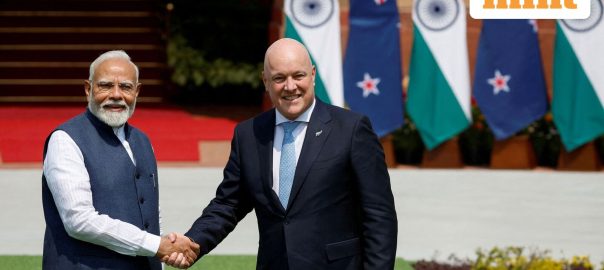
India and New Zealand have signed a comprehensive Free Trade Agreement (FTA), according to a government statement, marking a major economic and strategic milestone in India’s engagement with the Indo-Pacific region. The FTA will be signed at a later date, similar to the UK deal, where trade negotiations were concluded in May and the pact was formally signed in July. The FTA was jointly announced by Prime Minister Narendra Modi and New Zealand Prime Minister Christopher Luxon, the statement said. The deal stands out as one of India’s fastest-closing VTAs. The negotiations were formally launched on 16 March 2025 during the meeting of India’s Minister of Commerce and Industry Piyush Goyal and Todd McClay, the Minister of Trade and Investment, New Zealand. The agreement was concluded after five rounds of negotiations and several in-person and virtual sessions. Officials on both sides described the agreement as comprehensive in scope, covering goods, services, investment, rules of origin, customs facilitation, technical barriers to trade and sanitary and phytosanitary measures. The agreement aims to provide predictable market access and clearer regulatory pathways for businesses, while addressing long-standing concerns on both sides. For India, the FTA is part of a broader strategy to expand its trade footprint in the Indo-Pacific and diversify export markets at a time of global trade uncertainty. New Zealand, a major agricultural exporter with strong interests in the region, sees the agreement as a gateway to the Indian market and a way to strengthen economic engagement with one of the world’s fastest growing major economies. Bilateral trade between the two countries has grown steadily but remains relatively small. India’s merchandise trade with New Zealand reached $1.3 billion in 2024-25, up nearly 49% from FY24, albeit from a relatively modest base. Indian exports to New Zealand are dominated by pharmaceuticals, textiles, engineering goods and information technology services, while imports consist largely of agricultural products, including wool, fruits and dairy-related items. Officials said the agreement seeks to redress this imbalance by easing tariff and non-tariff barriers and encouraging two-way investment. Focusing on people, farm produce Goyal said: “Today, this free trade agreement is about building trade around people and launching opportunities – for our farmers, for our entrepreneurs, for our students, for our women and for our innovators. The agreement drives yields and farm incomes and drives modern agricultural productivity. It opens doors to your region through Indian well-integrated businesses and export businesses. learn, work and grow on a global stage.” The elimination of tariffs on 100% of its tariff lines will provide duty-free access for all Indian exports. This market access increases the competitiveness of India’s labour-intensive sectors, including textiles, apparel, leather, footwear, marine products, gems and jewellery, handicrafts, engineering goods and automobiles. This will benefit Indian artisans, women, youth and MSMEs—integrating them deeper into global value chains. According to the government statement, India has secured commitments across a wide range of high-value sectors, including IT and IT-enabled services, professional services, education, financial services, tourism, construction and other business services, opening new opportunities for Indian service providers and high-skill service providers. Commerce Secretary Rajesh Agrawal called it “a new generation trade agreement … with complementarity at its core.” “India’s Strengths [will] expand exports, support labor-intensive growth and power services. New Zealand is getting deeper, more predictable access to India’s large and growing economy. The movement of people-students, professionals and skilled workers converges these strengths,” Agrawal added. The FTA provides improved entry and residence provisions for Indian professionals, students and youth, including employment opportunities during studies, post-study work options, dedicated visa arrangements and a working holiday visa framework. Also envisaged is a new “temporary employment entry professional Indian occupation visa pathway a skilled visa pathway for Indian occupation 5,000 visas at any given time and a stay of up to three years,” the statement added. It will cover Indian professions such as AYUSH practitioners, yoga instructors, Indian chefs and music teachers, as well as professionals from high-demand sectors such as IT, engineering, healthcare, education and construction – strengthening workforce mobility and services – focus on a dedicated action plan, a dedicated action plan, an app-gri deal on productivity improvement, technology, research collaboration and quality improvement are envisaged to support income growth for Indian farmers. Under India’s Make in India vision, they are also expected to take advantage of their presence in New Zealand and gain access to the wider Pacific Island markets in 2014. Earlier agreements include: Mauritius in February 2021, the UAE (February 2022), Australia (April 2022), the European Free Trade Association (February 2024), the UK (July 2025), and Oman on December 18 this year and the final leg of the European Union (EU) arrangements were also negotiated New Delhi is expected to start trade talks with Qatar soon.