Families consisting of separated
parents have often been referred to as “broken†for hundreds of years. Even today, the federal government’s official term for a
family with coupled
parents and at least one child is “intact†and the nuclear model is still very much how we define families in contemporary Australia.
Despite
its decline, the nuclear
family continues to be promoted in advertising, and
advocated for in politics. It also became the centre of the marriage equality debate.
Raising children outside of a romantically involved couple is seemingly so unconventional, it deserves its own
sympathetic storyline on TV ratings giants like
Married at First Sight.
The ABC have promoted their new drama
The Heights, about a “blended” family, with the hook, “
sometimes things just work better when they’re brokenâ€.
Although the tagline makes an effort to put a positive spin on a term which has historically inflicted prejudice, children of separated
parents are definitely not looking to reclaim the term “broken familiesâ€.
</p>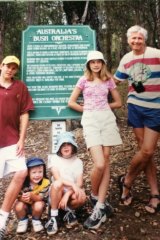
Sophie, second from the right, with her dad, right, and siblings 19 years ago.
The label not only characterises a personal situation beyond our control, but it has always intended to be insulting. Consider a
broken item, heart
break, financially
broke; it doesn’t take a genius to conclude just what kind of
family it is, if it is broken.
What is more, like a smashed glass — a momental misfortune on which you wish you could hit rewind — the ongoing rhetoric of growing up “broken†sends the message
that a parents’ separation somehow changes the course of their child’s life onto a less appealing path.
Believing
that a happier childhood, in which my
parents stayed
together, is in some other out-of-reach dimension would be to draw conclusions like
that my life would be better off if my beloved brother and sister — children of my father’s second marriage — didn’t exist. More broadly, it would be admitting
that my own existence is some kind of less desirable
Sliding Doors outcome.
In my experience, I adapted to, and subsequently enjoyed, growing up in my “unconventional” (but actually very common)
family dynamic. Not because seeing its value was making the best of a bad situation, but because it was my daily life by its own nature.
From the childhood joy of decorating two trees at Christmas time, to the teen angst of having two bedrooms to recluse in (and double the wall space for my Spice Girls posters); if my
family was broken, many times the pieces could be used as celebratory confetti.
While the visual of being sprawled across my
parents aged three may envoke a sense of separation — with Mum holding my writhing legs and Dad catching my clutching arms, as I fell into a crevasse between two parting parties — I believe defines my
family for the opposite reason: for a
family composition often perceived as dysfunctional, ironically, only the very functional can move between, and live across, two households.
I stayed with Mum
that night, as planned. Only the intact can jointly carry through with decisions against a wailing toddler.
Sophie Verass is a Sydney-based writer and the digital editor of SBS’s NITV.
Most Viewed in Lifestyle
<span class="_2wzgv D5idv _3lVFK">Loading
Source link
More