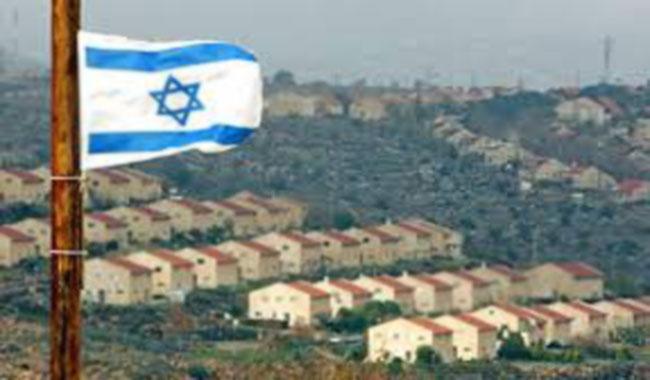
KFAR ETZION, Palestinian Territories: For Yohanan Ben Yaakov, taking part in the creation of the first
Israeli settlement in the occupied West Bank in 1967 was like returning home, he says.
Today, Israel’s 50-year occupation of Palestinian territory and its continuing
settlement building are seen as major stumbling blocks to any peace efforts.
But Ben Yaakov, who lives in Kfar Etzion, says the
settlement should be seen differently.
He was born there in the early 1940s, in what was **t yet a
settlement but a kibbutz, the collective communities Jews established even before Israel became a state.
Kfar Etzion was set up on land in an area that was **t yet referred to as the West Bank.
Along with others, he fled fighting in late 1947, but
returned after Israel’s victory in the Six-Day War, which lasted from June 5 to 10, 1967.
"Fifty years ago, I
returned home and I feel at home, just like my grandchildren today who grew up here," said the 72-year-old historian of the kibbutz, sharp despite a recent open-heart surgery.
His father and his uncle were the only members of the Polish family to escape the Nazis and took part in founding the kibbutz in 1943.
In 1947, when the United Nations approved a partition plan for what was then referred to as Palestine, setting off a war, he was evacuated with his mother and around 50 other children with their mothers.
On May 13, 1948, just before Israel’s declaration of independence, the kibbutz was taken by Jordanian forces in fighting that killed more than a hundred people, including his father.
The kibbutz museum reports 242 people lost their lives that day, while other accounts say 127 Jews were killed.
Ben Yaakov grew up with the other children, who nearly all lost their fathers.
"For 19 years, we kept saying that one day we will return home," he said.
"Once per year, for the anniversary of the fall of Kfar Etzion, we would gather near the Jordanian border and stare at a lone oak tree, a 100-year-old tree, a symbol of the village," said Ben Yaakov.
Israel’s victory in 1967 marked their chance to return.
He and a group of others also from Kfar Etzion obtained authorisation from Israel’s government to go back.
It became the first
settlement in the West Bank.
Numerous others would follow across the occupied territory after 1967.
More than 600,000 settlers currently live in the West Bank and east Occupied al-Quds alongside some 2.9 million Palestinians.
Such settlements are considered illegal under international law.
they are also built on land the Palestinians see as part of their future state.
Around Kfar Etzion, located south of Occupied al-Quds and Bethlehem, successive
Israeli governments
have created many other such settlements, forming a bloc referred to as Gush Etzion.
Israel sees the bloc of settlements as remaining under its control in any
settlement with the Palestinians, likely in some form of a land swap, unlike far-flung, isolated settlements that could be evacuated.
A junction near Gush Etzion has seen a ****** of Palestinian knife and car-ramming attacks against Israelis since 2015.
In 2014, the murder of three
Israeli teenagers abducted from a hitchhiking stop near Gush Etzion contributed to an escalation of violence that led to that year’s Gaza war.
Ben Yaakov however rejects the idea that Israelis can**t live alongside their Palestinian neighbours. He also rejects the "settler" label.
"How could I feel like a settler? I am at
home here," he said, reflecting an attachment to the land felt by many settlers, further complicating prospects for a peace deal.
Two of his four children
have chosen to remain in the kibbutz.
His oldest daughter Morit Yi**n, 45 and the mother of six children, including one who is an ******r in the
Israeli army, says she feels at
home in Kfar Etzion, calling it "the place that we will never leave".
A**ther resident, Eliaz Cohen, a proponent of dialogue between settlers and Palestinians, says that "living here and affirming our legitimate right to live on this land can only be done if all
Residents of this land
have the same rights". Ben Yaakov agrees, saying "we can**t continue to hold the Palestinian population hostage".
 أكثر...