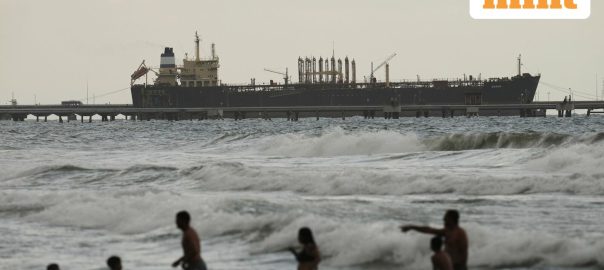
Another official was quoted as saying that the tanker was under sanctions, but added that it had not been boarded so far and that interceptions could take different forms – including by sailing or flying close to vessels of concern. Evana, an oil tanker, is docked at El Palito port in Puerto Cabello, Venezuela, Sunday, Dec. 21, 2025 (AP). The US Coast Guard is reportedly pursuing an oil tanker in international waters near Venezuela, in what would be the second such operation this weekend and the third in less than two weeks if successful. “The United States Coast Guard is actively searching for a sanctioned ‘dark navy’ vessel that is part of Venezuela’s illegal sanctions evasion,” a US official told Reuters. “It’s flying a false flag and under a judicial seizure order.” Another official was quoted as saying that the tanker was under sanctions, but added that it had not been boarded so far and that interceptions could take different forms – including by sailing or flying close to vessels of concern. Official sources did not give Reuters a specific location for the operation or the vessel being pursued. ‘Bella 1′ British maritime risk management group Vanguard, along with a US maritime security source, identified the vessel as Bella 1, a very large crude oil carrier that was added to the sanctions list by the US Treasury Department last year, which said the vessel had links to Iran. Bella 1 was empty as it approached Venezuela on Sunday, according to TankerTrackers.com. In 2021, the vessel provided transportation for Venezuela’s oil to China, according to internal documents from state-owned oil company PDVSA. It also previously carried Iranian crude, according to the vessel monitoring service. Trump’s pressure campaign The White House did not immediately respond to a request for comment on Sunday, while US President Donald Trump last week announced a “blockade” of all oil tankers under sanctions entering and leaving Venezuela. Trump’s pressure campaign on Venezuelan President Nicolas Maduro has included an increased military presence in the region and more than two dozen military attacks on vessels in the Pacific and Caribbean near the South American nation. At least 100 people were killed in the attacks. The Skipper, a very large crude carrier and the first Venezuela-related vessel seized by the US on December 10, reached the Galveston Offshore Lightering Area near Houston on Sunday. Many large crudes cannot be transported through the Houston Ship Channel as the waterway is not deep enough, and usually transfer the oil on board to smaller tankers at GOLA. The first two oil tankers seized operated on the black market and supplied oil to countries under sanctions, Kevin Hassett, director of the White House’s National Economic Council, said in a television interview on Sunday. “And so I don’t think people here in the U.S. need to worry that the prices are going to go up because of these seizures on these ships,” Hassett said on CBS’ “Face the Nation” program. “There are only a few of them, and they were black market ships.” But analysts said the new seizures could push oil prices slightly higher when Asian trade resumes on Monday. “We may see prices rise modestly at the opening, considering market participants may see this as an escalation with more Venezuelan barrels at risk” because the tanker intercepted on Saturday was not under US sanctions, UBS analyst Giovanni Staunovo said. Venezuelan President Nicolas Maduro said Wednesday that the country’s oil trade will continue. But the new U.S. focus on oil tankers will raise geopolitical risks and likely hurt Venezuela’s oil revenues, analysts said. The effects could be felt quickly as Venezuela’s export volumes drop significantly and oil storage tanks fill faster, forcing the OPEC producer to cut output, said Francisco Monaldi, director of the Latin America Energy Program at Rice University’s Baker Institute. (With input from Reuters)