How cognitive psychologists can enhance crime scene forensic

[ad_1]
When a jury decides the destiny of an individual, they accomplish that based mostly on the proof introduced to them within the courtroom. Proof obtained from forensic evaluation, similar to DNA evaluation, is usually interpreted as sturdy proof by jurors.
This notion of forensic proof is enhanced by common TV reveals like CSI: Crime Scene Investigation, the place bodily proof is used to resolve murders in a “whodunit” showdown between deductive cops and artful criminals overlaying their tracks. All it takes is the correct proof to piece the story collectively.
However latest analysis means that the truth of forensic evaluation is that it may be subjective and fallible. As an illustration, forensic proof can typically be ambiguous due to components such because the presence of DNA on samples that originates from multiple individual.
When forensic proof is ambiguous, contextual data (similar to data of a confession) might affect how forensic examiners consider the proof. This distortion of their analysis is named contextual bias and has been acknowledged to be a purpose why miscarriages of justice happen.
Our analysis agrees with this latest analysis that contextual data might affect the choices of forensic examiners. However this may increasingly not essentially be a nasty factor. We imagine it’s untimely to take away context from forensic evaluation. Contextual bias on the a part of a forensic examiner doesn’t essentially imply that errors will likely be made.
It’s tough for psychologists within the UK to make suggestions in regards to the results of context on forensic examiners as a result of the analysis to this point has been pretty restricted, notably within the the way in which it has been performed.
For instance, some research had a really small pattern dimension. Some lacked a management group. In others, accuracy was not measured. Because of this the researchers couldn’t know for sure if contributors would have carried out otherwise if no contextual data had been accessible to them. So it has been tough to generalize in regards to the results of contextual bias on forensic examiners’ choices.
Bias doesn’t equal error
However our research presents the concept that contextual data doesn’t essentially all the time result in inaccurate determination making.
First, forensic proof will likely be generated from each the crime scene and the suspect, which means that the fingerprints left at a criminal offense scene are extra doubtless than to not match the fingerprints of the suspect. For that reason, contextual data (similar to data of a confession) that biases forensic examiners in the direction of discovering a match might result in extra correct choices being made.
Contextual data may additionally inform the examiner which checks to conduct. If the examiner is aware of which questions they have to reply, then they could keep away from nugatory checks. However this additionally means they could overlook one thing. For instance, one piece of analysis cited a rape-homicide case. On this case, a forensic laboratory was instructed by detectives to solely analyze the proof for semen samples. This meant that the forensic examiners missed blood samples that turned out to be integral to the case.
Based mostly on this instance, researchers acknowledged that contextual ignorance might have extra of a adverse impact on forensic choices than contextual bias. This view is supported by psychological research which have proven that biased determination processes can result in correct determination outcomes.
Influence on jury choices
Regardless of the potential optimistic results, it might stay ethically and legally inappropriate for forensic examiners to make use of contextual data. As an illustration, jurors might interpret the several types of proof, similar to a confession and forensic proof, as being unbiased of each other.
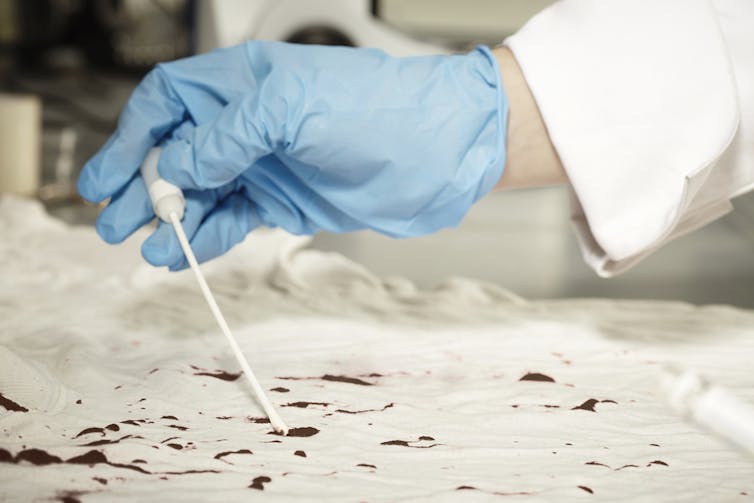
But when contextual data similar to a confession aids the interpretation of forensic proof, jurors might incorrectly suppose that every piece of proof independently helps the opposite when this isn’t truly the case. Because of this jurors could possibly be overestimating the probabilities of a defendant being responsible.
Our evaluation means that issues referring to the research of contextual bias in forensic examiners – small pattern dimension, no accuracy measure and failure to make use of a management group – makes it tough for implications and suggestions to be drawn.
We propose that future analysis employs the talents of each forensic examiners and cognitive psychologists. Then each ability units can be utilized to create sensible experiments. Examiners have the required data of each lab environments and forensic proof, however we imagine that entry to this data will assist psychologists design extra rigorous experiments focused in the direction of the research of contextual bias in forensic examiners. Solely then can correct conclusions be drawn about whether or not contextual bias is a assist or a hindrance.
This text is republished from The Dialog by Lee John Curley, Lecturer in Psychology, The Open College and James Munro, Psychology Researcher, Edinburgh Napier College beneath a Artistic Commons license. Learn the unique article.
[ad_2]
Supply hyperlink


