Lab-grown mini brains may quickly outsmart us

[ad_1]
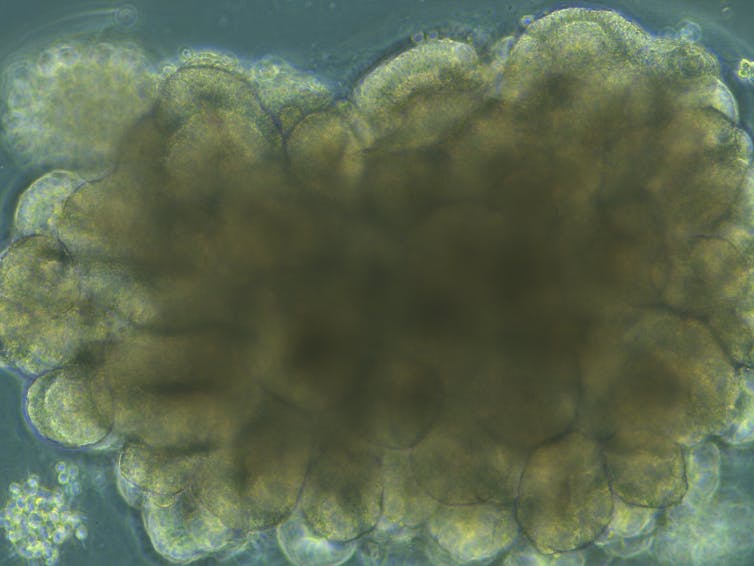
The cutting-edge methodology of rising clusters of cells that set up themselves into mini variations of human brains within the lab is gathering increasingly consideration. These “mind organoids,” made out of stem cells, provide unparalleled insights into the human mind, which is notoriously troublesome to review.
However some researchers are fearful {that a} type of consciousness may come up in such mini-brains, that are typically transplanted into animals. They might no less than be sentient to the extent of experiencing ache and affected by being trapped. If that is true – and earlier than we contemplate how probably it’s – it’s completely clear in my thoughts that we should exert a supreme stage of warning when contemplating this concern.
Mind organoids are at the moment quite simple in comparison with human brains and may’t be acutely aware in the identical approach. On account of a scarcity of blood provide, they don’t attain sizes bigger than round 5 or 6 millimeters. That mentioned, they’ve been discovered to supply mind waves which might be much like these in untimely infants. A research has confirmed they will additionally develop neural networks that reply to gentle.
There are additionally indicators that such organoids can hyperlink up with different organs and receptors in animals. That implies that they not solely have a prospect of turning into sentient, in addition they have the potential to speak with the exterior world, by accumulating sensory data. Maybe they will in the future really reply by sound units or digital output.
As a cognitive neuroscientist, I’m blissful to conceive that an organoid maintained alive for a very long time, with a continuing provide of life-essential vitamins, may ultimately develop into sentient and possibly even totally acutely aware.
Time to panic?
This isn’t the primary time organic science has thrown up moral questions. Gender reassignment shocked many previously, however, no matter your beliefs and ethical convictions, intercourse change narrowly issues the person present process the process, with restricted or no organic influence on their entourage and descendants.
Genetic manipulation of embryos, in distinction, raised alert ranges to sizzling crimson, given the very excessive probability of genetic modifications being heritable and probably altering the genetic make-up of the inhabitants down the road. For this reason profitable operations of this sort carried out by Chinese language scientist He Jianku raised very robust objections worldwide.
However creating mini-brains inside animals, and even worse, inside a man-made organic setting, ought to ship us all frantically panicking. In my view, the moral implications go properly past figuring out whether or not we could also be making a struggling particular person. If we’re making a mind – nonetheless small –– we’re making a system with a capability to course of data and, down the road, given sufficient time and enter, probably the power to suppose.
Some type of consciousness is ubiquitous within the animal world, and we, as people, are clearly on high of the size of complexity. Whereas we don’t know precisely what consciousness is, we nonetheless fear that human-designed AI might develop some type of it. However thought and feelings are more likely to be emergent properties of our neurons organized into networks by growth, and it’s more likely it may come up in an organoid than in a robotic. This can be a primitive type of consciousness or perhaps a full blown model of it, supplied it receives enter from the exterior world and finds methods to work together with it.
In concept, mini-brains could possibly be grown endlessly in a laboratory – whether or not it’s authorized or not – growing in complexity and energy for so long as their life-support system can present them with oxygen and very important vitamins. That is the case for the most cancers cells of a girl referred to as Henrietta Lacks, that are alive greater than 60 years after her loss of life and multiplying right this moment in tons of of hundreds of labs all through the world.
Disembodied tremendous intelligence?
But when brains are cultivated within the laboratory in such situations, with out time restrict, may they ever develop a type of consciousness that surpasses human capability? As I see it, why not?
And in the event that they did, would we be capable to inform? What if such a brand new type of thoughts determined to maintain us, people, in the dead of night about their existence – be it solely to safe sufficient time to take management of their life-support system and be sure that they’re protected?
Once I was an adolescent, I typically had scary goals of the world being taken over by an enormous pc community. I nonetheless have that fear right this moment, and it has partly develop into true. However the scare of a organic super-brain taking on is now a lot higher in my thoughts. Take into account that such new organism wouldn’t have to fret about their physique turning into previous and dying, as a result of they might not have a physique.
This may increasingly sound like the primary traces of a foul science fiction plot, however I don’t see causes to dismiss these concepts as endlessly unrealistic.
The purpose is that we’ve to stay vigilant, particularly provided that this might all occur with out us noticing. You simply have to think about how troublesome it’s to evaluate whether or not somebody is mendacity when testifying in courtroom to grasp that we’ll not have a simple process making an attempt to work out the hidden ideas of a lab grown mini-brain.
Slowing the analysis down by controlling organoid dimension and life span, or broadly agreeing a moratorium earlier than we attain some extent of no return, would make good sense. However sadly, the rising ubiquity of organic labs and tools will make enforcement extremely troublesome – as we’ve seen with genetic embryo enhancing.
It will be an understatement to say that I share the concerns of a few of my colleagues working within the subject of mobile drugs. The hardest query that we will ask relating to these mesmerizing prospects, and which additionally applies to genetic manipulations of embryos, is: can we even cease this?
This text is republished from The Dialog by Guillaume Thierry, Professor of Cognitive Neuroscience, Bangor College beneath a Artistic Commons license. Learn the unique article.
Learn subsequent:
5 milestones that formed 50 years of web historical past
[ad_2]
Supply hyperlink


