The UK illegally copied delicate EU knowledge — however the EU doesn’t appear to care

[ad_1]
On July 24, high-level EU officers lastly confirmed the UK made unlawful copies of labeled private info from an EU database. Regardless of this, it doesn’t appear the EU Fee appears will take any motion, which — to involved members of European Parliament — highlights its and EU member states’ hypocritical and harmful method to individuals’s privateness.
When Julian King, the European commissioner for safety, acknowledged the existence of the key report detailing the UK’s unlawful and sloppy knowledge practices — which the EU Observer revealed in 2018 — he added that “there are a selection of member states which have challenges on this space.” Whereas the comment might need been made to lower the severity of the UK’s infraction, for MEP Sophie in ‘t Veld it solely hints at an even bigger systemic drawback.
“We by no means hear about some of these instances till it seems within the media or someone leaks paperwork. This isn’t how a democracy works, there’s presupposed to be accountability and transparency,” in ‘t Veld informed TNW. “The European Fee doesn’t appear to grasp that, and nor do the member states’ governments. That is ridiculous.”
The UK authorities made unlawful copies of the #Schengen Info System, incl images & fingerprints of EU residents and gave entry to US corporations ❌
Will the @EU_Commission current findings of an in depth & swift inquiry to @Europarl_EN? Questions from @RenewEurope LIBE⤵️ pic.twitter.com/HDtZkq8Z4o
— Sophie in ‘t Veld (@SophieintVeld) July 26, 2019
For this reason in ‘t Veld and her fellow Renew Europe MEPs are asking the Fee to make a full inquiry into doable unlawful knowledge breaches by member states and share them with the European Parliament, so MEPs can fulfill their power-checking position.
Secrecy doesn’t serve the individuals
The key report, which MEPs didn’t have entry to earlier than EU Observer’s reveal, outlined years value of violations by British authorities after they obtained restricted entry to the Schengen Info System (SIS) again in 2015.
The SIS is an EU-run database which comprises names, biographic info, pictures, fingerprints, and arrest warrants for nearly half 1,000,000 non-EU residents denied entry into the Schengen zone. Along with that, it has private info, corresponding to biometric knowledge, of greater than 100,000 lacking individuals and 36,000 suspected criminals.
The UK sloppily made full and partial copies of the database, and saved it on laptops at airports and authorities places of work, making it weak to additional breaches. British authorities additionally gave personal US contractors, corresponding to IBM, entry to the info, which suggests the knowledge may very well be requested by US authorities beneath the Patriot Act.
Now if this info is generally shared to cease crime, what’s the massive deal about spreading it? Effectively, as a result of the UK used static variations of the database (i.e. the unlawful copies), it means authorities usually labored with outdated info — probably letting criminals go by means of or unnecessarily stopping individuals already cleared from SIS. In ‘t Veld acknowledges using restricted private info and trendy expertise is required to catch the ‘dangerous guys’ — however we dwell in a democracy the place there are limits to authorities powers.
Residents belief governments to deal with their info in line with the regulation, so in case of a breach they should be held accountable. In ‘t Veld and her colleagues imagine some of these knowledge breaches shouldn’t be stored from the general public or from Parliament. If there are certainly extra knowledge breaches like Commissioner King hints at, they have to be totally investigated and made public to verify there are checks and balances to authorities powers.
Most individuals have come round to the significance of privateness after revelations of malpractices of huge tech corporations corresponding to Fb, however individuals stay unaware that our governments are additionally responsible of mishandling knowledge.
“There must be indignation, however as a substitute there’s full silence — and possibly additionally ignorance — about how public authorities are dealing with our knowledge, and our civil rights,” in ‘t Veld explains. “And there’s ignorance, as a result of authorities don’t discuss it, they hold it a secret. So how are they any higher than Mark Zuckerberg?”
Governments must be held to the identical requirements as Zuckerberg
Europe is certainly on the forefront of privateness and GDPR is a real feat of regulation — but it surely doesn’t utterly apply to authorities operations as they have been moved to a separate directive. For in ‘t Veld, this was a elementary mistake which additionally exhibits how hypocritical the EU’s lax stance on governments’ unlawful dealing with of non-public knowledge is.
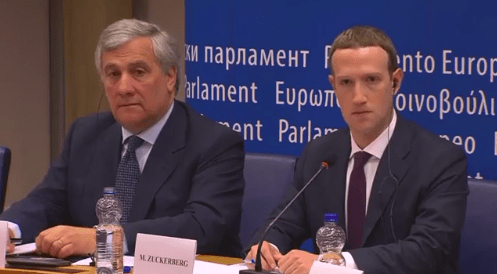
The UK and the EU summoned Zuckerberg to reply for the Cambridge Analytica debacle and felony investigations have been launched. However these similar authorities are mum on their very own abuse of information, such because the commercialization air passengers’ private info, about which in ‘t Veld and her colleagues have sent inquiries to the Fee.
In ‘t Veld believes it’s about time the Fee holds member states and authorities companies to the identical requirements as others. “It’s not even a matter of ‘observe what you preach.’ It’s respect the regulation and be punished if you happen to don’t — as a result of that’s what occurs to regular residents and corporations.”
Brexit strain
The UK’s imminent departure from the European Union is bringing to a raft of points, as commonplace procedures have been upended by the chaos. As with different privileges and accesses it was awarded as a consequence of its EU membership, the UK has made overtures to remain in varied info sharing agreements with reference to safety after Brexit.
In ‘t Veld thinks this may possible occur, however not as a consequence of a grand deal or political breakthrough — it’ll merely be established with on-going negligence.
“I feel the European Fee and different member states will merely flip a blind eye and proceed to offer UK entry, whereas not being certain in any approach to EU requirements. I feel that’s what they’ll do as a result of that’s what they’re already doing with the US.”
MEPs like in ‘t Veld are deeply dissatisfied by the Fee’s sweeping of the UK’s unlawful knowledge dealing with beneath the rug. It’s an enormous concern and different non-governmental entities wouldn’t obtain as a lot slack. For this reason in ‘t Veld believes the UK — and some other nation that’s been discovered responsible of unlawful conduct (if the Fee will ever reveal them) — must be taken to court docket.
“If you happen to cross the road by one millimeter, try to be charged,” in ‘t Veld said.
Brexit is about to occur on October 31 (and Boris Johnson swears this may occur), so in ‘t Veld and her colleagues expect a swift response from the Fee — hoping it’ll maintain governments to the identical privateness requirements as anybody else.
[ad_2]
Supply hyperlink


