the robots who will likely be your colleagues, not your replacements

[ad_1]
The newest industrial robots seem like petting zoo variations of the massive machines discovered in lots of fashionable factories – small, cute, and you’ll play with them. However don’t be deceived by their cuddly look. They’ve the potential to alter the way in which people work with machines and disrupt the prevailing marketplace for industrial robots.
The massive distinction with this new era of robots is that they don’t should function in closed-off areas. As a substitute they will safely function alongside and even collaborate with human staff. Because of this, these machines are sometimes referred to as collaborative robots or “cobots.”
Absolutely automating a manufacturing unit isn’t all the time fascinating as a result of fashionable manufacturing corporations want flexibility to shortly alter their processes for a wide range of merchandise and customization. As a substitute, producers in such contexts are more and more in search of automation with a human contact.
That is the place cobots can are available in. Even when full automation with bigger, sooner industrial robots is extra environment friendly, cobots can enable factories to extend their output whereas retaining a level of flexibility.
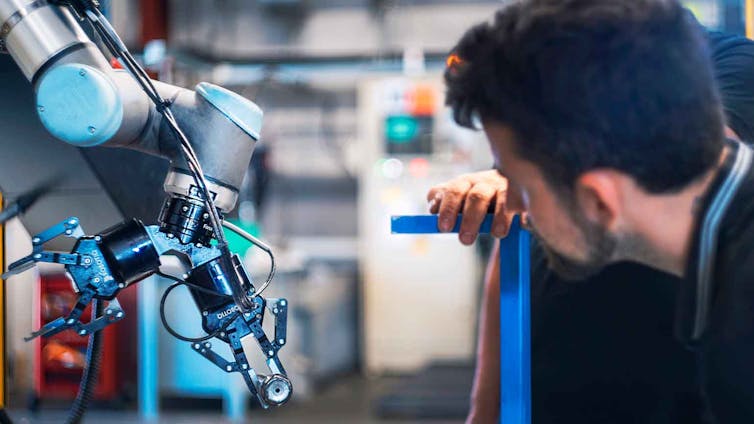
For now, cobots are used for particular duties. For instance, cobots take up the tedious and repetitive activity of fastening every of the screws in a battery pack from the arms of their fellow people. Fairly than changing human jobs, cobots could create new jobs in purposes, through which their energy, endurance and precision is mixed with human dexterity, flexibility and downside fixing.
A promising use is in industrial meeting the place a number of components are built-in in a remaining product. On this a part of the manufacturing course of, people nonetheless perform 90 % of the duties. Sooner or later, cobots will decide, place and mount the elements, and the human employee will finalize and examine the output.
Disruptive innovation
For industrial robots, nevertheless, the danger of being changed by cobots is rather more actual than for human staff. For now, gross sales of cobots kind lower than 5 % of the marketplace for industrial robots, through which just a few massive corporations nonetheless dominate. However we argue the robotics business is ripe for disruptive innovation by comparatively small new entrants.
The incumbent corporations are likely to deal with standard, heavy-load industrial robots for big quantity manufacturing of automobiles, electronics or meals merchandise. However these robots additionally overshoot the wants of small and medium-sized companies that lack the funds or experience to make use of such programs.
Cobots, then again, can do issues that aren’t sometimes related for present clients of large-scale industrial robots, however that are very enticing to different customers. As an example, they are often moved across the manufacturing unit ground and simply be refitted with grippers for brand new purposes.
Cobots are straightforward to setup and alter, extremely versatile, and might collaborate with people. And these capabilities will likely be significantly related as extra new clients undertake cobots and discover new makes use of for them. Our analysis on drones has proven that the potential of recent applied sciences is usually past what even their producers can envision.
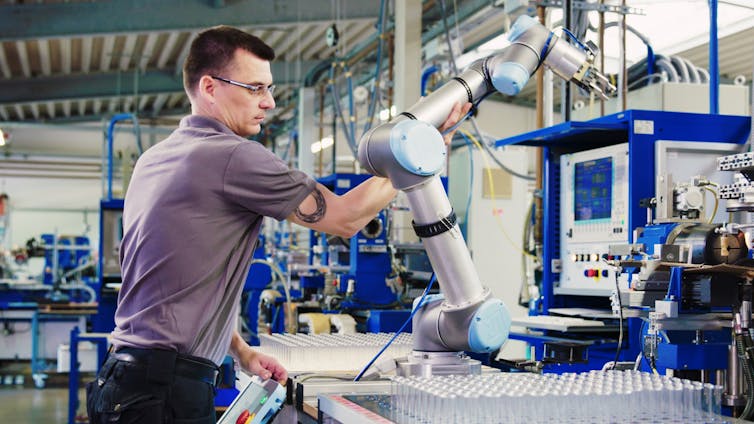
As cobots’ pace, accuracy and skill to hold heavy masses continues to get higher in coming years, they are going to more and more have the ability to compete with conventional industrial robots and so there’s a very good probability that mainstream clients may even begin to undertake them as effectively.
This poses an issue for the incumbent producers. The likes of ABB, Kuka and Fanuc have a really small market share in cobots compared to the brand new entrants, equivalent to Denmark’s Common Robots. It is because they’re so used to catering to the wants of their current clients and it’s more durable to know the wants of cobot customers within the rising market.
However they may get round this downside by as an alternative listening to their very own workers who already use cobots to fabricate industrial robots. This may enable the incumbent companies to find out about rising person wants and defend themselves from the upcoming disruption.
Whereas it’s troublesome to foretell the longer term, it seems very believable that the “social expertise” of cobots will find yourself making them extra common than the commercial robots in the long run. Proper now they could look like small ponies, however in the future cobots might turn out to be the versatile and highly effective work horses of the manufacturing unit.
This text is republished from The Dialog by Ali Ahmad Malik, PhD Analysis Fellow, Human-robot groups in manufacturing, College of Southern Denmark; Ferran Giones, Assistant Professor in Expertise Entrepreneurship, College of Southern Denmark, and Tim Schweisfurth, Affiliate Professor for Expertise and Innovation Administration, College of Southern Denmark beneath a Artistic Commons license. Learn the unique article.
Learn subsequent:
Why Dutch Railways is following an API-first dev technique
[ad_2]
Supply hyperlink


