How life on Earth was boosted by an asteroid collision 446m years in the past

[ad_1]
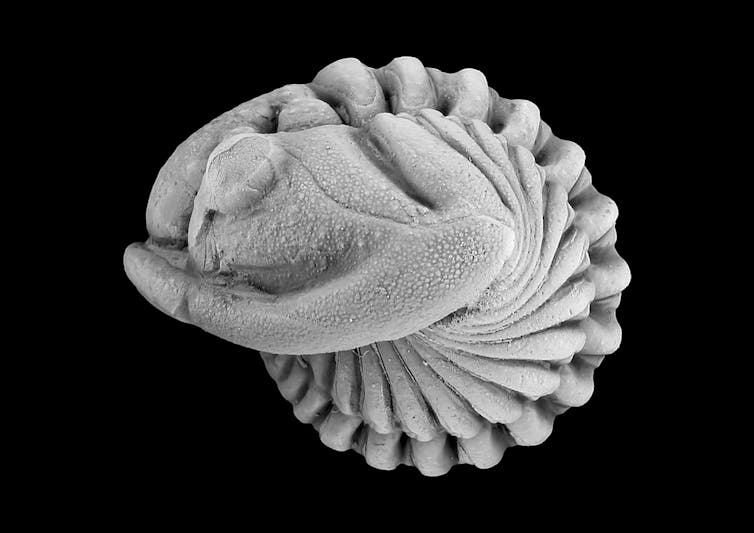
One thing mysterious occurred practically half a billion years in the past that triggered probably the most necessary adjustments within the historical past of life on Earth. Out of the blue, there was an explosion of species, with the biodiversity of invertebrate animals growing from a really low degree to one thing just like what we see as we speak. The preferred clarification for this “Nice Ordovician Biodiversification Occasion” is that it was a results of an uncomfortably scorching Earth cooling and finally heading into an ice age.
However what really triggered the change in temperature? In our new paper, revealed in Science Advances, we present that its onset coincided precisely with the most important documented asteroid breakup within the asteroid belt in the course of the previous two billion years, attributable to a collision with one other asteroid or a comet. Even as we speak, nearly a 3rd of all meteorites falling on Earth originate from the breakup of this 150 kilometer-wide asteroid between Jupiter and Mars.
Following this occasion, monumental quantities of mud would have unfold by means of the photo voltaic system. The blocking impact of this mud might have partly stopped daylight from reaching the Earth – resulting in cooler temperatures. We all know that this concerned the local weather altering from being roughly homogeneous to changing into divided into local weather zones – from Arctic situations on the poles to tropical situations on the equator. The excessive range amongst invertebrates, together with inexperienced algae, primitive fish, cephalopods and corals, got here as an adaptation to the brand new local weather.
Swedish sea ground
Our proof comes from detailed research of sea ground sediments of Ordovician age (485m-443m years in the past) uncovered at Kinnekulle in southern Sweden and Lynna River close to St. Petersburg in Russia. In a quarry at Kinnekulle, we discovered greater than 130 “fossil meteorites” – rocks that fell on Earth within the historic previous, which turned embedded in sea ground sediments and have been preserved similar to animal fossils.
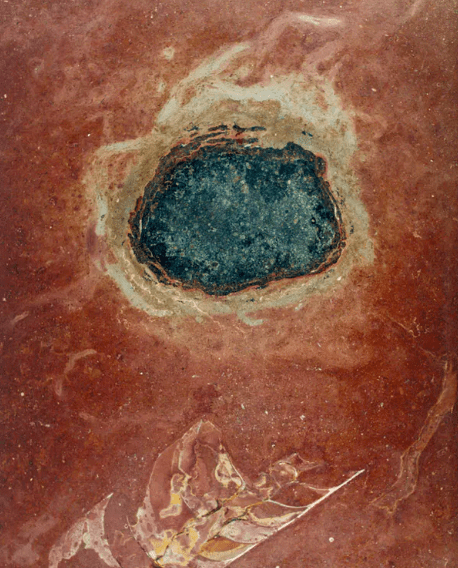
All however one in every of these fossil meteorites, that are as much as 20cm in diameter, have the identical composition – they’re all particles from the identical collision. Certainly, they have been made up of the identical sort of fabric as the massive asteroid that broke up within the asteroid belt on the time. The opposite meteorite in all probability originates from the smaller physique that hit the massive asteroid.
We all know that the asteroid collision passed off 466m years in the past. This may be dated by taking a look at isotopes (variants of chemical components with a unique variety of neutrons within the nucleus) in not too long ago fallen meteorites from the Ordovician asteroid breakup. The fossil meteorites within the quarry should due to this fact characterize the fabric that was transported to Earth instantly after the breakup. And given the massive variety of meteorites that we discovered on the ocean ground, we are able to estimate that the flux of meteorites to Earth will need to have been orders of magnitude greater again then than it’s as we speak.
However how do we all know that this bombardment created an enormous quantity of mud that lowered the temperature? We additionally studied the distribution of very fine-grained, micrometer-sized mud within the sedimentary strata. We might decide that it had an extraterrestrial origin by detecting helium and different substances integrated within the sediments that might solely be defined by the photo voltaic wind having bombarded the mud, enriching it with these components on its technique to Earth.
Our outcomes clearly present that big quantities of fine-grained mud reached Earth shortly after the breakup. And the geological document reveals that shortly after the mud arrived, the ocean degree fell dramatically worldwide – the start of the ice age. That was as a result of the ocean water was transferred to the excessive latitudes, the place giant ice sheets fashioned.
The outcome was fully surprising – we’ve got over the last 25 years leaned in opposition to very totally different hypotheses by way of understanding what occurred throughout this era. For instance, whereas we suspected that the diversification occasion was one way or the other linked to the asteroid breakup, we believed that the various small asteroids that additionally reached Earth from the breakup, slightly than the mud, had one thing to do with the adjustments. It wasn’t till we bought the final helium measurements that all the things fell into place.
Classes for local weather analysis
International warming continues as a consequence of carbon dioxide emissions, and the temperature rise is biggest at excessive latitudes. In response to the Intergovernmental Panel on Local weather Change, we’re approaching a state of affairs that’s harking back to the situations that prevailed previous to the asteroid collision 466m years in the past. Clearly, persevering with on that route is just not going to be good for biodiversity.
Within the final decade or so, researchers have mentioned totally different synthetic strategies to chill the Earth in case of a serious local weather disaster. One resolution can be to position asteroids, very like satellites, in orbits round Earth in such a method that they constantly liberate high-quality mud and therefore partly block the warming daylight.
Our outcomes present for the primary time that such mud at occasions has cooled Earth dramatically, giving hopes that it may very well be a viable synthetic resolution. Our research can provide a extra detailed, empirical-based understanding of how this works that can be utilized to create and consider pc fashions of such occasions.
However for the foreseeable future, there isn’t any different technique to sort out local weather change than to cut back our carbon emissions. In the end, that’s the solely technique to protect the spectacular increase within the range of life that occurred all these 466m years in the past.
This text is republished from The Dialog by Birger Schmitz, Professor of Nuclear Physics, Lund College beneath a Artistic Commons license. Learn the unique article.
[ad_2]
Supply hyperlink


