Combating for intercourse helps animals survive habitat loss, new beetle analysis says

[ad_1]
Animals world wide are seeing their environments change. Local weather change is inflicting heating and adjustments to climate patterns, the oceans have gotten extra acidic, and beforehand undisturbed habitats are being altered and degraded by human actions.
If we wish to perceive how these adjustments will have an effect on animals world wide, we want a greater understanding of how their biology would possibly decide how effectively they survive these adjustments. My colleagues and I’ve simply revealed analysis that demonstrates how vital an animal’s mating system is to this. We discovered that species whose males compete for mates usually tend to survive damaging adjustments to their surroundings.
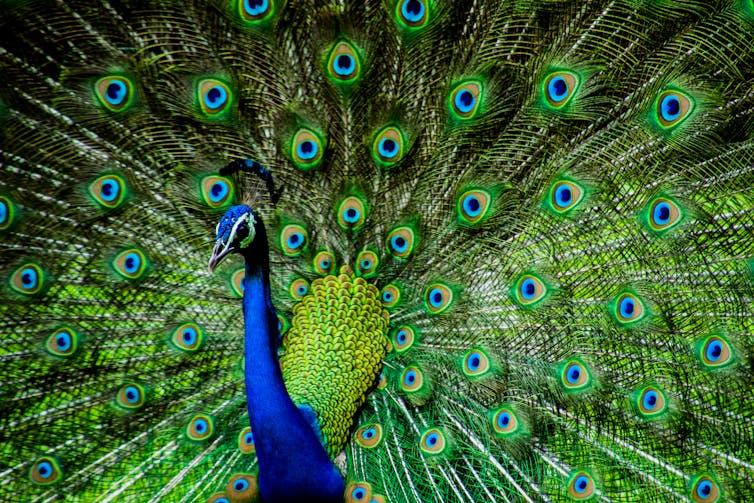
In lots of species, males attempt to woo females with alerts like calls, coloration or lengthy tails, or they attempt to monopolize entry to females by preventing different males with weaponry like horns or antlers. This competitors for mates helps drive the evolution of those species, in a course of known as sexual choice. Probably the most engaging or most aggressive mates usually tend to cross on their genes to the following technology and produce extra offspring with their engaging options or aggressive nature.
There are a lot of causes to assume aggressive mating might have an effect on the resilience of a species to environmental change. First, the alerts and weapons that always evolve in these species the place competitors is extra intensive are expensive to develop and to hold. They’ll make animals extra conspicuous to predators, and each contests with rival males and indulgent shows to females can use huge quantities of vitality. So these strongly sexually chosen species might be much less ready to deal with environmental change due to these prices.
On the flip aspect, sturdy competitors between males for mates implies that just a few notably sturdy, wholesome or energetic males “win” and father nearly all of the following technology. If the surroundings is altering, then males which are genetically finest suited to the brand new surroundings are prone to be in the very best situation. If these males find yourself because the winners within the competitors for mating then their well-adapted genes will unfold very quickly.
So sturdy sexual choice might make animal populations adapt quicker to new environments, making them extra resilient within the face of it altering.
So which course of is extra vital in influencing species survival? A collection of lab research have persistently discovered that sturdy sexual choice improves outcomes for animal species when the surroundings shifts from their optimum. However research of animals within the subject have typically discovered both no impact of sexual choice or the other. For instance, when birds have been launched to islands comparable to New Zealand, then the species which are extra sexually chosen are much less prone to change into established.
One attainable cause for this disparity is that the sphere research have typically focused on very small populations of animals. It’s attainable that the results of sexual choice on a inhabitants’s resilience fluctuate with its measurement.
Very small populations dwelling in a sure location may not have sufficient genetic selection to provide people which are very effectively tailored to its specific surroundings. Through which case, the prices of sexual choice might make them extra prone to go extinct. Whereas massive populations usually tend to have the genetic selection that can produce “successful” males even when the surroundings is unfriendly.
What was wanted was a subject examine of sexual choice and persistence in bigger populations. To that finish, my colleagues and I carried out a examine, revealed in Ecology Letters, of how dung beetles reply to environmental change within the rainforest of Sabah in Malaysian Borneo.
Sexy beetles
Dung beetles are fascinating animals for a lot of causes, considered one of which is the range of their intercourse lives. Males from the acquainted ball-rolling species do compete for matings.
However there are additionally many species of dung beetle that don’t roll, as an alternative burying dung immediately beneath the place they discover it, and these species present a lot larger variability. Some species have males with horns, which they use in fights with different males, whereas others are much less strongly sexually chosen, with hornless males who’re much less aggressive of their pursuit of mates.
Utilizing an current large-scale examine known as the SAFE Challenge, we adopted 34 species of beetle present in untouched “outdated progress” forest. We checked out how they fared in lightly-logged and closely logged forest after which oilpalm plantation the place the unique forest was largely eliminated.
We discovered that these species with horns had been extra prone to survive in all these instances. Strikingly, all 11 remaining species in probably the most disturbed plantation surroundings carried horns.
We additionally in contrast species with comparatively small horns in opposition to these with large horns for his or her measurement. We discovered that beetle species with large horns are usually not solely extra prone to survive in disturbed environments, however in addition they are inclined to have bigger remaining inhabitants sizes.
This tells us that – in some specific instances no less than – we should always take into consideration sexual choice in addition to different elements of an animal’s biology if we wish to predict or to handle inhabitants sizes within the face of environmental change. Sexual choice is a ubiquitous and highly effective drive driving evolution within the animal kingdom and has been intensively studied by behavioral and evolutionary biologists. Possibly now it’s time ecologists and wildlife administration specialists began to consider it as effectively.
This text is republished from The Dialog by Rob Knell, Reader in Evolutionary Ecology, Queen Mary College of London beneath a Inventive Commons license. Learn the unique article.
[ad_2]
Supply hyperlink


