Electrical vehicles aren’t sufficient to cut back emissions, we want various fuels

[ad_1]
Electrical vehicles are sometimes seen as one of many nice hopes for tackling local weather change. With new fashions arriving in showrooms, main carmakers retooling for an electrical future, and a small however rising variety of customers wanting to convert from gasoline guzzlers, EVs seem to supply a means for us to decarbonize with little change to our lifestyle.
But there’s a hazard that fixating on electrical vehicles leaves a big blind spot. Electrification could be very costly for the lumbering lorries that haul items throughout continents or is at present technically prohibitive for long-distance air journey.
Past all the keenness surrounding electrification, at present light-duty passenger automobiles solely comprise 50 p.c of complete international demand for power within the transportation sector in comparison with 28 p.c for heavy street automobiles, 10 p.c for air, 9 p.c for sea and a pair of p.c for rail.
Put merely, the present concentrate on electrifying passenger automobiles – although welcome – represents solely a part of the reply. For many different segments, fuels might be wanted for the foreseeable future. And even for vehicles, electrical automobiles aren’t a cure-all.
The unlucky fact is that, on their very own, battery electrical automobiles (BEVs) can not remedy what we name the “100 EJ downside”. Demand for transport companies are anticipated to rise dramatically within the coming many years. So the Worldwide Vitality Company (IEA) initiatives that we have to considerably scale back the quantity of power every car makes use of simply to maintain complete international power demand within the transport sector roughly flat at present ranges of 100 exajoules (EJ) by 2050. Greater than half of that 100 EJ remains to be anticipated to return from petroleum merchandise and, by then, the share of light-duty automobiles in transport sector power demand is anticipated to say no from 50 p.c to 34 p.c.
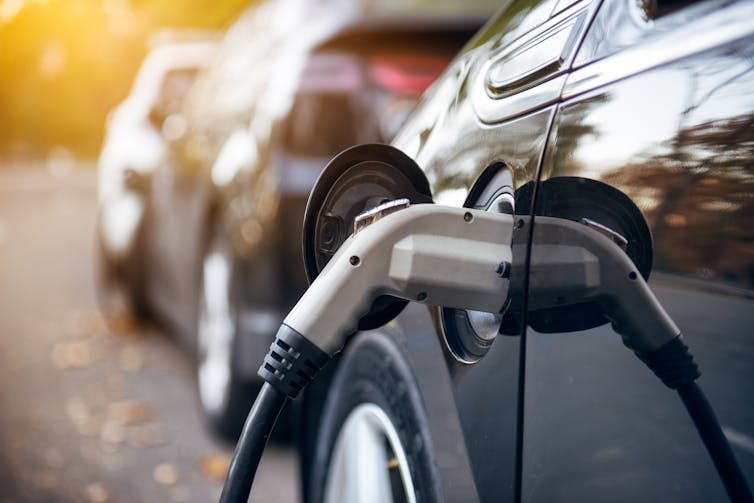
The overwhelming majority of current passenger journeys will be accommodated by current battery electrical automobiles so, for a lot of customers, shopping for one might be a simple determination (as prices come down). However for many who often take very lengthy journeys, the main target additionally must be on lower-carbon fuels.
Petroleum substitutes may prolong sustainable transport to heavier automobiles and people in search of longer vary, whereas utilizing the prevailing refueling infrastructure and car fleet. Whereas battery electrical automobiles will impose wider system prices (for instance, the charging infrastructure wanted to attach tens of millions of latest electrical automobiles to the grid), all of the transition prices of sustainable gas substitutes are within the fuels themselves.
Our latest research is a part of a renewed concentrate on artificial fuels or synfuels (fuels transformed from feedstocks apart from petroleum). Synfuels had been first made on an industrial scale within the 1920s by turning coal into liquid hydrocarbons utilizing the so known as Fischer-Tropsch synthesis, named after its unique German inventors. However utilizing coal as a feedstock produces far dirtier gas than even typical petroleum-based fuels.
One attainable path to carbon-neutral artificial fuels could be to make use of woody residues and wastes as feedstock to create artificial biofuels with much less affect on the surroundings and meals manufacturing than crop-based biofuels. An alternative choice could be to provide synfuels from CO₂ and water utilizing low-carbon electrical energy. However producing such “electrofuels” would want both an influence system that could be very low price and ultra-low-carbon (reminiscent of these of Iceland or Quebec) or require devoted sources of zero-carbon electrical energy which have excessive availability all year long.
Pilot vegetation
Artificial biofuels and electro-fuels each have the potential to ship sustainable fuels at scale, however these efforts are nonetheless on the demonstration stage. Audi opened a €20M e-gas (electro-fuel) plant in 2013 that produces 3.2 MW of artificial methane from 6 MW of electrical energy. The €150M Swedish GoBiGas plant was commissioned in 2014 and produced artificial biomethane at a scale of 20 MW utilizing 30 MW of biomass.
Regardless of the various virtues of carbon-neutral artificial fuels although, most commercial-scale initiatives are at present on maintain. That is as a result of excessive funding price of pioneer course of vegetation mixed with an absence of sufficiently sturdy authorities insurance policies to make then economically viable and share the chance of scale-up.
Authorities and business makes an attempt to encourage folks to purchase electrical automobiles aren’t an issue in themselves. Our concern is that an unique concentrate on electrification might make fixing the 100 EJ downside not possible. It’s too early to inform which, if any, sustainable fuels will emerge profitable and so essentially the most urgent want is to scale up manufacturing from the present demonstration stage. If not, when our consideration lastly turns away from shiny electrical automotive ads in just a few years, we’ll discover ourselves at a standing begin in addressing the remainder of the issue.
This text is republished from The Dialog by David Reiner, College Senior Lecturer in Expertise Coverage, Cambridge Decide Enterprise Faculty and Ilkka Hannula, Affiliate Researcher, Vitality Coverage Analysis Group, College of Cambridge underneath a Inventive Commons license. Learn the unique article.
[ad_2]
Supply hyperlink


