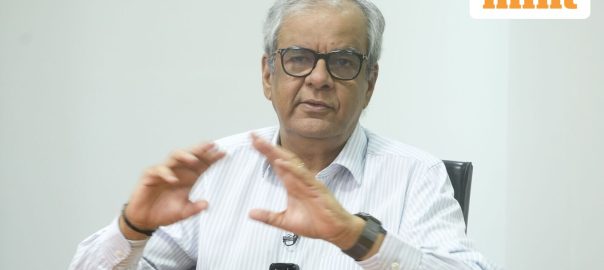
Ashok Vaswani, Managing Director and Chief Executive Officer, Kotak Mahindra Bank. Summary Kotak Mahindra Bank is the holding company that fully owns all 20 subsidiaries of the financial services group. But unlike peers like ICICI Bank and HDFC, Kotak CEO Ashok Vaswani sees little value in going public with subsidiaries. That’s why Kotak Mahindra Bank Ltd currently sees little value in listing its subsidiaries and selling a stake to “foreigners” and will instead focus on building an enduring institution, Chief Executive Officer Ashok Vaswani said, even as peers floated their units during India’s record IPO boom. History shows that when a private or public sector bank has sold a significant stake, they have brought overseas buyers, Vaswani, who will complete two years at the helm of India’s fourth-largest private lender by assets in January, told Mint in an interview. “We’re not here for a day in the sun or a quarter in the sun; we’re here to build a lasting, lasting, lasting franchise,” Vaswani said. “The foreigner brought no talent, the foreigner brought no brand. Yet the foreigner, 10 years later, made out like a bandit. What is the value that the person who sold obtained?” Kotak Mahindra Bank is the holding company that fully owns all 20 subsidiaries of the financial services group. It also has three associated companies: Infina Finance Pvt Ltd (49.99% stake), Phoenix ARC Pvt Ltd (49.9%), and Zurich Kotak General Insurance Company (India) Ltd. While Vaswani is not keen on bringing in a foreign partner in its subsidiaries, Kotak sold 70% in its general insurance subsidiary to Zurich Insurance 5.20 Company in June 5.20 crore and now owns the remaining 30%. “In our case, our businesses are doing well, and we are gaining momentum every year,” Vaswani said. “You get built-in value creation in Kotak, and why would I overlook that built-in value creation? Especially when my goal is not to just book profits on one particular day.” Rival lender ICICI Bank Ltd recently listed its asset management company, a joint venture with Prudential Plc, in a $1.2-billion IPO. HDFC Bank Ltd unveiled its non-bank lending arm HDB Financial Services in July, while State Bank of India (SBI) announced plans to list SBI Funds Management, its joint venture with French asset manager Amundi. The domestic market has seen a surge in listings this year as companies benefited from demand for shares from investors, led by mutual funds. According to a Dec. 9 Bloomberg report, India’s initial public offerings hit a record ₹1.77 trillion, surpassing the 2024 high of ₹1.73 trillion. As a financial conglomerate, Vaswani said the Kotak Group can tap into all customer profiles, be it in loans, insurance, capital markets or investments. “I like to think of Kotak as an airplane flying on a couple of engines.” “There’s of course the banking engine or, let’s say, the lending engine. There’s the insurance engine, there’s the asset management engine and the capital markets. And if I can keep all this kind of flying, it gives a lot of assurance that if one of the engines explodes, then the other engines still keep the plane flying and rising,” says Vaswani. Beyond its current subsidiaries, Vaswani said the bank is exploring “every single inorganic opportunity”, but it has to make strategic sense and meet valuation expectations. While the bank has made acquisitions in the past, it has made a few purchases in the past two years. The bank bought microfinance company Sonata Finance in March 2024 for ₹537 crore. Earlier in January, it bought Standard Chartered Bank’s ₹3,330 crore personal loan portfolio. Kotak Mahindra Bank is also considered a competitor to IDBI Bank. Without commenting on IDBI Bank, Vaswani said an inorganic opportunity should give Kotak a large number of customers, provide a lot of deposits or add to the portfolio, among other things. “Strategically, if it’s a tick and valuation is a tick, then we’ll try to do the deal,” he said. “That’s why we really like these portfolio acquisitions, like the Standard Chartered personal loan book or Sonata.” Analysts are not too keen on Kotak stepping into the IDBI deal. In an email accompanying his note to clients, Suresh Ganapathy, managing director and head of financial services research, Macquarie Capital, said: “I really hope they stay away from this IDBI buyout as in our view it is quite negative if they merge or take a 40-50% stake and it could be a downgrade event of the bank which is currently maintaining a high capital ratio. Depresses its return on equity (ROE) – a measure of profitability. Kotak Mahindra Bank has a capital adequacy or risk buffer of 20 basis points (bps) over a year ago. The bank’s RoE shrank to 10.65% a year ago. Kotak Mahindra Bank is India’s fourth largest private lender by assets, behind HDFC Bank, ICICI Bank and Axis Bank. “Overall, excess capital is just a good thing because it enables you to weather any kind of downside, any thunderstorms that occur on the downside. It allows you to take advantage of opportunities on the upside,” Vaswani said. He added that the ROE has been partially suppressed by credit costs, and as those costs improve, so will the ROE. “As we automate and digitize, you’ll see the cost-to-asset ratio decrease, which should also improve ROEs,” Vaswani said. The cost-to-asset ratio is expenses as a percentage of total assets and measures the operating efficiency of a bank.