How the US census kickstarted America’s computing trade

[ad_1]
The U.S. Structure requires {that a} inhabitants rely be carried out at first of each decade.
This census has at all times been charged with political significance, and continues to be. That’s clear from the controversy over the conduct of the upcoming 2020 census.
But it surely’s much less extensively identified how vital the census has been in creating the U.S. pc trade, a narrative that I inform in my new ebook, “Republic of Numbers: Surprising Tales of Mathematical People via Historical past.”
Inhabitants progress
The one use of the census clearly specified within the Structure is to allocate seats within the Home of Representatives. Extra populous states get extra seats.
A minimalist interpretation of the census mission would require reporting solely the general inhabitants of every state. However the census has by no means confined itself to this.
A complicating issue emerged proper at first, with the Structure’s distinction between “free individuals” and “three-fifths of all different individuals.” This was the Founding Fathers’ notorious mealy-mouthed compromise between these states with a lot of enslaved individuals and people states the place comparatively few lived.
The primary census, in 1790, additionally made non-constitutionally mandated distinctions by age and intercourse. In subsequent a long time, many different private attributes had been probed as effectively: occupational standing, marital standing, academic standing, fatherland and so forth.
Because the nation grew, every census required better effort than the final, not merely to gather the info but in addition to compile it into usable kind. The processing of the 1880 census was not accomplished till 1888. It had develop into a mind-numbingly boring, error-prone, clerical train of a magnitude hardly ever seen.
Because the inhabitants was evidently persevering with to develop at a fast tempo, these with ample creativeness may foresee that processing the 1890 census can be grotesque certainly with out some change in process.
A brand new invention
John Shaw Billings, a doctor assigned to help the Census Workplace with compiling well being statistics, had intently noticed the immense tabulation efforts required to take care of the uncooked knowledge of 1880. He expressed his considerations to a younger mechanical engineer aiding with the census, Herman Hollerith, a current graduate of the Columbia Faculty of Mines.
On Sept. 23, 1884, the U.S. Patent Workplace recorded a submission from the 24-year-old Hollerith, titled “Artwork of Compiling Statistics.”
By progressively bettering the concepts of this preliminary submission, Hollerith would decisively win an 1889 competitors to enhance the processing of the 1890 census.
The technological options devised by Hollerith concerned a set of mechanical and electrical units. The primary essential innovation was to translate knowledge on handwritten census tally sheets to patterns of holes punched in playing cards. As Hollerith phrased it, within the 1889 revision of his patent utility,
“A gap is thus punched similar to particular person, then a gap in accordance as particular person is a male or feminine, one other recording whether or not native or overseas born, one other both white or coloured, &c.”
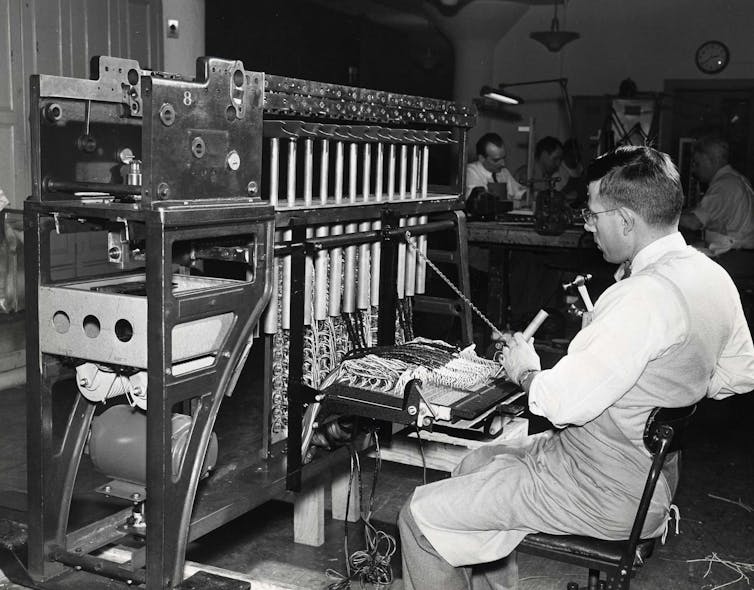
This course of required creating particular equipment to make sure that holes might be punched with accuracy and effectivity.
Hollerith then devised a machine to “learn” the cardboard, by probing the cardboard with pins, in order that solely the place there was a gap would the pin go via the cardboard to make {an electrical} connection, ensuing prematurely of the suitable counter.
For instance, if a card for a white male farmer handed via the machine, a counter for every of those classes can be elevated by one. The cardboard was made sturdy sufficient to permit passage via the cardboard studying machine a number of instances, for counting totally different classes or checking outcomes.
The rely proceeded so quickly that the state-by-state numbers wanted for congressional apportionment had been licensed earlier than the top of November 1890.
Rise of the punched card
After his census success, Hollerith went into enterprise promoting this expertise. The corporate he based would, after he retired, develop into Worldwide Enterprise Machines – IBM. IBM led the best way in perfecting card expertise for recording and tabulating massive units of information for quite a lot of functions.
By the 1930s, many companies had been utilizing playing cards for record-keeping procedures, comparable to payroll and stock. Some data-intensive scientists, particularly astronomers, had been additionally discovering the playing cards handy. IBM had by then standardized an 80-column card and had developed keypunch machines that might change little for many years.
Card processing turned one leg of the mighty pc trade that blossomed after World Warfare II, and IBM for a time can be the third-largest company on this planet. Card processing served as a scaffolding for vastly extra fast and space-efficient purely digital computer systems that now dominate, with little proof remaining of the outdated regime.
Those that have grown up figuring out computer systems solely as simply moveable units, to be communicated with by the contact of a finger and even by voice, could also be unfamiliar with the room-size computer systems of the 1950s and ’60s, the place the first technique of loading knowledge and directions was by making a deck of playing cards at a keypunch machine, after which feeding that deck right into a card reader. This continued because the default process for a lot of computer systems effectively into the 1980s.
As pc pioneer Grace Murray Hopper recalled about her early profession, “Again in these days, all people was utilizing punched playing cards, and so they thought they’d use punched playing cards without end.”
Hopper had been an vital member of the workforce that created the primary commercially viable general-purpose pc, the Common Automated Pc, or UNIVAC, one of many card-reading behemoths. Appropriately sufficient the primary UNIVAC delivered, in 1951, was to the U.S. Census Bureau, nonetheless hungry to enhance its knowledge processing capabilities.
No, pc customers wouldn’t use punched playing cards without end, however they used them via the Apollo Moon-landing program and the peak of the Chilly Warfare. Hollerith would probably have acknowledged the direct descendants of his 1890s census equipment nearly 100 years later.
This text is republished from The Dialog by David Lindsay Roberts, Adjunct Professor of Arithmetic, Prince George’s Neighborhood Faculty beneath a Inventive Commons license. Learn the unique article.
[ad_2]
Supply hyperlink


