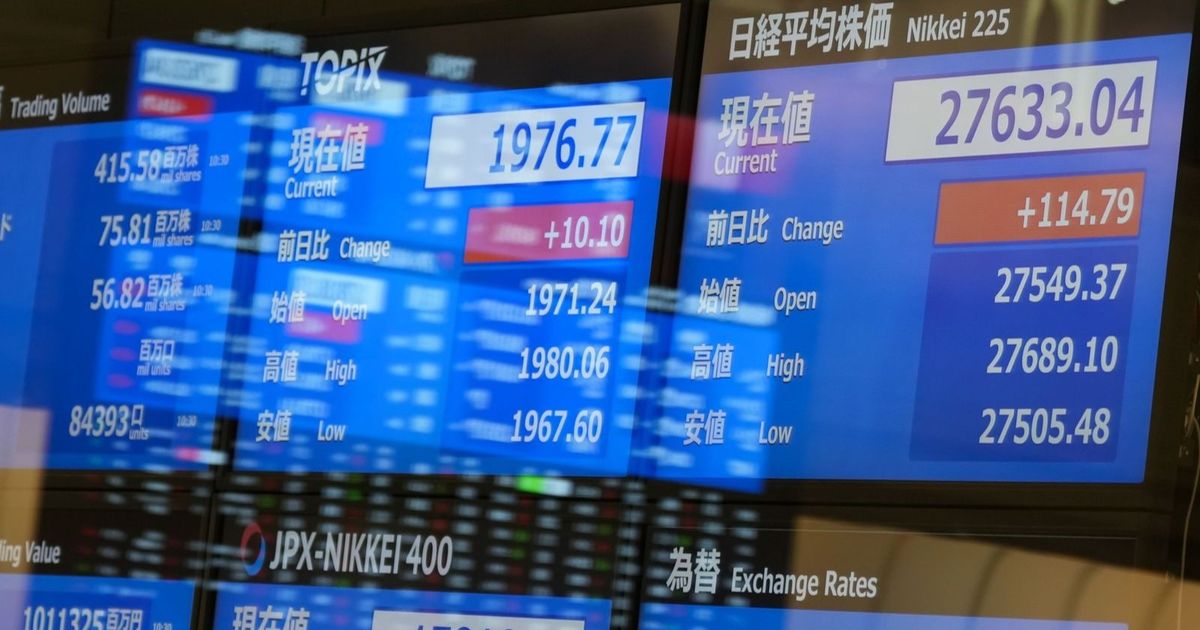
U.S. stock index futures rose along with Asian shares after a volatile week, with growing optimism about the Federal Reserve’s prospects for cutting interest rates. S&P 500 futures were up 0.4% at the start of the week, after the main index ended Friday’s session higher following a turbulent period that included selling off riskier assets. Nasdaq 100 futures rose 0.6%. Shares in Hong Kong, Australia and South Korea also advanced, while the market in mainland China remained stable. While Japanese markets were closed due to a public holiday. Oil fell after posting its biggest weekly loss since early October as traders weighed the possibility of a peace deal between Ukraine and Russia that could increase crude flows into a market facing the risk of an oversupply. Gold fell slightly for the third day. Risk appetite improves on Wall Street Risk appetite improves on Wall Street after reports on Friday that US officials held preliminary talks to allow Nvidia to sell H200 artificial intelligence chips to China. The market also got another boost after New York Fed President John Williams hinted at the possibility of a rate cut in the near term. Also read: The Trump administration is considering the possibility of allowing “Nvidia” to sell artificial intelligence chips to China. Wall Street ended a tumultuous week with stocks turning higher after a wave of selling shook some of the market’s most speculative assets, testing the nerves of investors after a strong surge. “Given the moves we saw last week, and the potential for continued volatility in the coming days, it would be natural for investors to be reluctant to bet too heavily on positive risk sentiment,” said Nick Tweedale, senior analyst at AT Global Markets. Sharp fluctuations shake the markets and eyes are on the Fed. Markets saw a strong return to volatility last week with growing doubts about the Federal Reserve’s ability to cut interest rates, raising concerns among investors. Assets favored by individual traders, including cryptocurrencies and AI-related stocks, traded sharply higher, while a sell-off in Asian technology shares pushed the MSCI Asia-Pacific index to its biggest weekly drop since April. Treasuries rose on Friday after Williams, seen as a close ally of Fed Chairman Jerome Powell, said he saw room for monetary policy easing in the near term as risks of a decline in employment increase and risks of a rise in inflation increase. As traders increased their bets on a rate cut in December, officials remained divided, with Boston Fed President Susan Collins saying she had not yet decided on her position. Traders are now pricing in a probability of more than 60% for a rate cut in December. Earlier this month, the odds of a quarter-point cut next month were less than 50%. The market is monitoring the path of cryptocurrencies. Attention is turning to the cryptocurrency market after a significant increase in volatility last week and a decline in Bitcoin. On Monday, Bitcoin fluctuated after a temporary bounce over the weekend amid headwinds from macroeconomic uncertainty and outflows from ETFs. Market sentiment remained cautious with traders monitoring $85,200 as a key support level. The largest cryptocurrency traded near $88,000, paring most of its early losses after a 2.3% drop. It rose more than 4% on Sunday. “The recent wave of selling and volatility is somewhat linked to other highly volatile or highly debt-dependent assets like Bitcoin,” Jun Pei Liu, founding partner at Ten Cap, said in an interview with Bloomberg TV. European anxiety … and Sino-Japanese tensions. Elsewhere, the euro and the British pound stabilized while markets also focused on financial pressures in Europe. The French National Assembly rejected part of the 2026 budget in the early hours of Saturday morning, in a move that highlights the uncertainty surrounding Prime Minister Sebastien Lecornu’s approach to addressing the ballooning deficit. The British government said at the weekend it would freeze train prices in the budget to be announced on Wednesday. The move comes as part of a series of measures to support affordability as Treasury Secretary Rachel Reeves seeks to offset the political impact of the need to raise up to 25 billion pounds ($33 billion) from tax increases and rein in spending to achieve financial stability. In other geopolitical developments, the dispute between China and Japan continued as China sent a letter to the United Nations, while Japan’s defense minister said during a visit to a military base near Taiwan that plans to deploy missiles at the site were going ahead on schedule, amid rising tensions between Tokyo and Beijing over the island. Meanwhile, US Secretary of State Marco Rubio said President Donald Trump’s proposed November 27 deadline to ensure Ukraine’s support for the US-backed peace plan was not final, and could potentially extend into next week. His warning came after US-Ukrainian talks in Geneva Sunday, which both sides described as making progress on a deal.