Tremendous-soldier T-cells battle most cancers higher after a transformational DNA supply

[ad_1]
Credit score:
Wikipedia Commons
I get pleasure from on-line procuring. Nonetheless, I typically discover myself fussing concerning the supply choices throughout checkout. It’s because not all supply providers are equally environment friendly and stress-free.
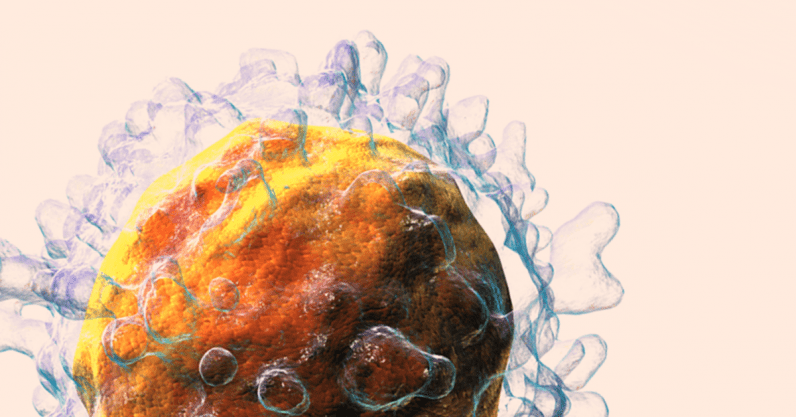
This private expertise has additionally impressed my analysis. As a postdoctoral scholar at Stanford College, I’ve engineered tiny nano-materials – objects about 10,000 occasions smaller than a grain of rice – to higher ship DNA into white blood cells referred to as T-cells that defend us in opposition to most cancers. My technique – which I consider because the equal of FedEx and UPS – delivers DNA effectively to T-cells that then transforms them into super-soldiers for monitoring and attacking most cancers cells.
The promise of immuno-medicine
Regardless of many years of analysis, most cancers stays a difficult illness to deal with as a result of most cancers cells mutate quickly, turning into immune to remedies similar to chemotherapeutic medicine and radiation. The World Well being Group estimates that in 2018, near 10 million people died of most cancers. The estimated financial price because of remedies and misplaced productiveness when sufferers couldn’t work throughout remedy was a whopping US$1.2 trillion, and that is anticipated to extend with an getting older inhabitants.
Within the 1990s James Allison and Tasuku Honjo, who gained the 2018 Nobel Prize in Drugs or Physiology for most cancers immunotherapy, found that most cancers cells can inhibit T-cells and stop them from detecting tumor cells. They pioneered a technique utilizing proteins referred to as antibodies to bind to most cancers cells. This prevents the most cancers cells from interfering with T-cells and suppressing them.
The second kind of most cancers immunotherapy, which I examine, entails genetically engineering T-cells with tailor-made DNA. The DNA I insert into T-cells encodes proteins that perform like weapons that kill most cancers cells sooner earlier than they get an opportunity to develop new mutations.
Sadly, it isn’t straightforward to ship DNA into cells, and the prevailing strategies are insufficient and will compromise the cancer-fighting capabilities of T-cells. Some T-cells could grow to be hyperactive after DNA supply and assault the sufferers’ personal organs.
Enhancing DNA supply
There are two predominant methods to ship DNA into T-cells. The primary makes use of viruses to ship DNA. The second makes use of bulk electroporation, a method that makes use of electrical energy to punch holes within the cells permitting the DNA to enter. Nonetheless, each are inefficient and have a number of disadvantages.
Viruses insert their very own viral DNA into host cells alongside the therapeutic DNA throughout supply. That is harmful, because the long-term consequence of getting viral genes in our physique is unknown. Viruses may also set off poisonous immune responses similar to persistent fever and even loss of life. One other drawback is that viruses can carry solely small packages of DNA, making it tough to cram the newest gene modifying instruments inside them.
These shortcomings paved the best way for electroporation. This technique works by subjecting cells to robust electrical fields that create holes in cells’ membrane and permit DNA to move by way of. Nonetheless, this method is akin to a courier blasting holes in an individual’s house to ship packages. I and others have proven that this method harms the T-cells and dampens their cancer-fighting capacity.
The facility of nano-engineering
To bridge this technological hole, I’ve developed a brand new approach named magnetic nano-electro-injection, or MagNEI, that may ship DNA into T-cells as much as 4 occasions extra effectively than virus and bulk electroporation. That is needed to provide excessive numbers of genetically engineered T-cell troopers – one billion or so – wanted to battle most cancers.
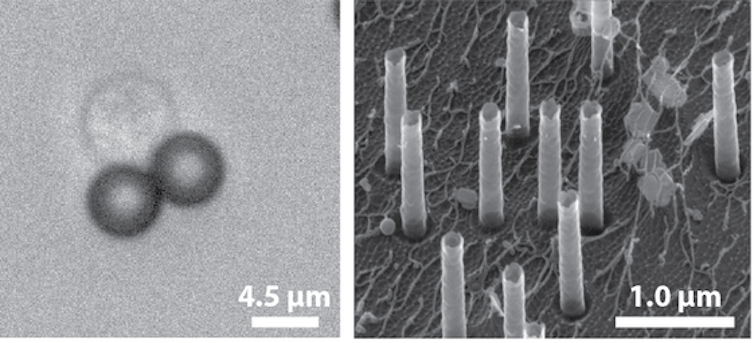
That is how MagNEI works. I first enhance the T-cells with FDA-approved magnetic particles to activate them and make them extra receptive to DNA supply. Then I exploit magnets to safe these cells onto hole nano-tubes. These tubes are 10,000 occasions smaller in diameter than a grain of rice. Subsequent, electrical fields are utilized by way of the nano-tubes to create small pores, or tunnels, into the cell membrane for DNA to enter cells. Magnetic forces then direct DNA into the nucleus of the cell. It is a a lot gentler process than electroporation.
New metrics to evaluate supply strategies
Moreover taking a look at DNA supply effectivity – the proportion of cells which can be efficiently remodeled with genetically engineered DNA – it’s also vital to contemplate the opposite penalties of assorted supply strategies. For instance, I’ve discovered that the power of engineered T-cell troopers emigrate and seek out most cancers cells may be weaker after DNA supply.
For my part, the most cancers immunotherapy group must increase past easy assessments similar to effectivity and cell survival to guage the utility of latest DNA supply strategies.
Due to this fact, in a current evaluation, I proposed a framework with new standards for evaluating which DNA supply strategies are simplest. One method to assess the influence of DNA supply is to measure how the exercise of particular genes are altered by the supply of international DNA.
As an example, I discovered that bulk electroporation causes vital adjustments within the exercise of genes linked to metabolism. Which will clarify why cells handled with this technique develop slowly. This discount in cell progress can improve manufacturing prices of those engineered T-cells and lengthen the remedy time for sufferers.
Magnet-based nano-scale strategies similar to mine provide benefits over virus and bulk electroporation for DNA supply, however so far, I’ve examined them solely in animal research and in experiments exterior of human our bodies. Sooner or later, I hope to make use of nano-materials for delivering DNA to create cell-based therapies.
This text is republished from The Dialog by Andy Tay, Postdoctoral Analysis Fellow in Supplies Science and Engineering, Stanford College underneath a Inventive Commons license. Learn the unique article.
[ad_2]
Supply hyperlink


