Ocean ecosystems take 2 million years to get better after mass extinction

[ad_1]
Round 66 million years in the past, a large asteroid struck the Earth, inflicting the extinction of the dinosaurs, ammonites, and plenty of different species.
The asteroid was equally devastating at a microscopic degree, driving ocean plankton to near-extinction. This crippled the bottom of the marine meals chain and shut down vital ocean capabilities, such because the absorption and supply of carbon dioxide from the environment to the ocean flooring.
Given the actual menace of a sixth mass extinction occasion led to by human-caused local weather breakdown and habitat disruption, we needed to learn the way lengthy the ocean ecosystem took to reboot after the final one. What we discovered has grave implications for the long-term outlook of marine ecosystems ought to we tip the vital base of its meals chain over the edge of extinction.
The nannoplankton virtually completely worn out 66 million years in the past – also referred to as coccolithophores – at the moment are widespread as soon as extra within the sunlit higher oceans. Though roughly 100 occasions smaller than a grain of sand, they’re so plentiful that they’re seen from area as swirling blooms within the ocean floor.
When these microscopic plankton die, they go away behind beautiful armored exoskeletons often called coccospheres made out of the mineral calcite, composed of bonded calcium and carbon. Together with the useless plankton cells, these skeletons slowly fall to the ocean flooring, forming a muddy calcium and carbon-rich sediment. As this sediment compacts, it types chalk and limestone, leaving us with iconic landscapes corresponding to white chalk cliffs – the shallow sea flooring of a forgotten age, since lifted up by tectonic exercise.
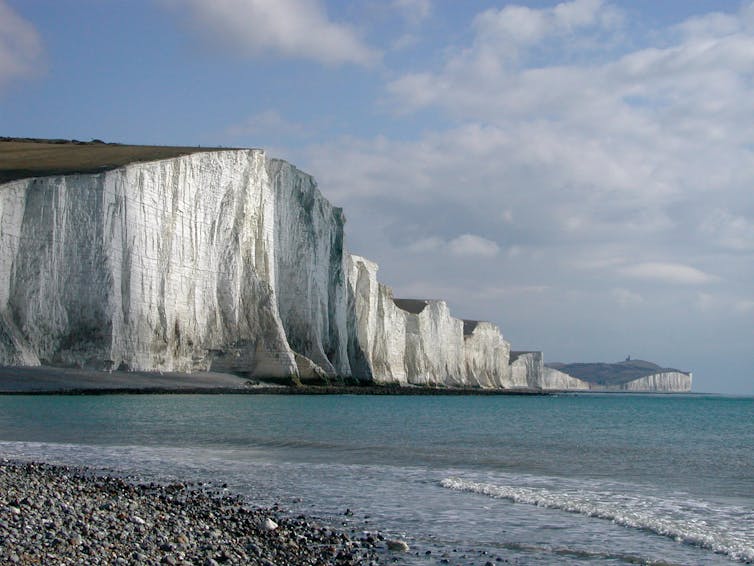
Conserved inside this compacted sediment is a steady fossil report stretching again 220m years. It’s this fossil report – probably the most plentiful on the planet – that may inform us how ecosystems responded to the extinction of nannoplankton. Modifications within the range and abundance of the plankton that after lived within the ocean above mirror the environmental modifications that performed out within the millennia after the large asteroid hit.
We extracted a steady core of deep-sea sediment from the Pacific Ocean. For the primary 13m years after the mass extinction occasion, we took a pattern of the fossil report at intervals of 13,000 years. We measured fossil abundance, range and cell sizes from over 700,000 specimens, producing in all probability the biggest fossil dataset ever produced from a single website.
2 million years for stability, 10 million for range
These fossil knowledge revealed that the plant-like, photosynthetic plankton bounced again virtually instantly – in all probability inside a couple of thousand years after the mass extinction. Nonetheless, the earliest communities have been extremely unstable and made up of only a handful of species with unusually small cell sizes, because the determine above exhibits.
Whereas the calcite skeletons of bigger plankton cells can sink to the ocean flooring, the skeletons of those smaller organisms descend a lot much less usually, as an alternative getting “recycled” within the higher ocean by hungry plankton. Communities with bigger cell sizes weren’t reestablished till two million years later, restoring their vital switch of carbon to the ocean flooring to pre-extinction ranges.
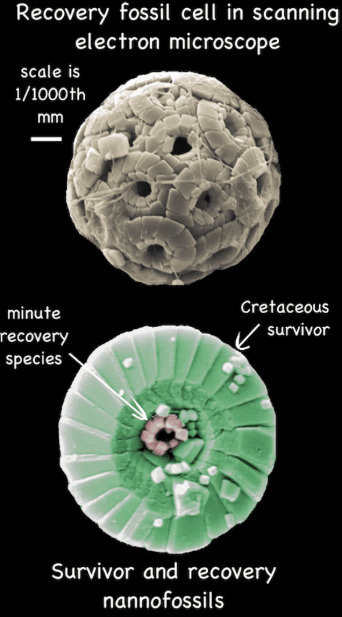
By this time, the variety of totally different plankton species had additionally elevated. This genetic range allowed them to increase right into a higher vary of ocean habitats, offering higher resilience to environmental change, and a safe basis on the base of the ocean meals internet.
This stability then supported enlargement within the abundance and variety of bigger plankton, fish, mammals, and birds depending on these meals sources. However though secure and resilient ecosystems had returned by two million years after the mass extinction, it took an extra eight million years for species numbers to completely get better to their earlier ranges.
A warning from the previous
At the moment’s marine ecosystems are nonetheless simply as depending on the plankton at their base as they have been up to now. Research present that populations of modern-day plankton have already declined by as a lot as 40 %, and that 70 % of species are migrating in the direction of the poles. We nonetheless don’t totally perceive how plankton species may lastly be pushed to extinction, however the fossil report exhibits us that extinction is strongly formed by local weather change.
If we feature on emitting carbon and interfering with marine ecosystems, we run the danger of shedding one in every of its vital carbon-storing and food-providing gamers. Analysis exhibits that that might take nature thousands and thousands of years to reverse.
This text is republished from The Dialog by Paul Bown, Professor of Micropalaeontology, UCL; Samantha Gibbs, Lecturer, Nationwide Oceanography Centre, College of Southampton, and Sarah Alvarez, Lecturer in Life and Earth Sciences, College of Gibraltar underneath a Artistic Commons license. Learn the unique article.
Learn subsequent:
Ghost Recon Breakpoint is an underwhelming tackle the Ubisoft method
[ad_2]
Supply hyperlink


